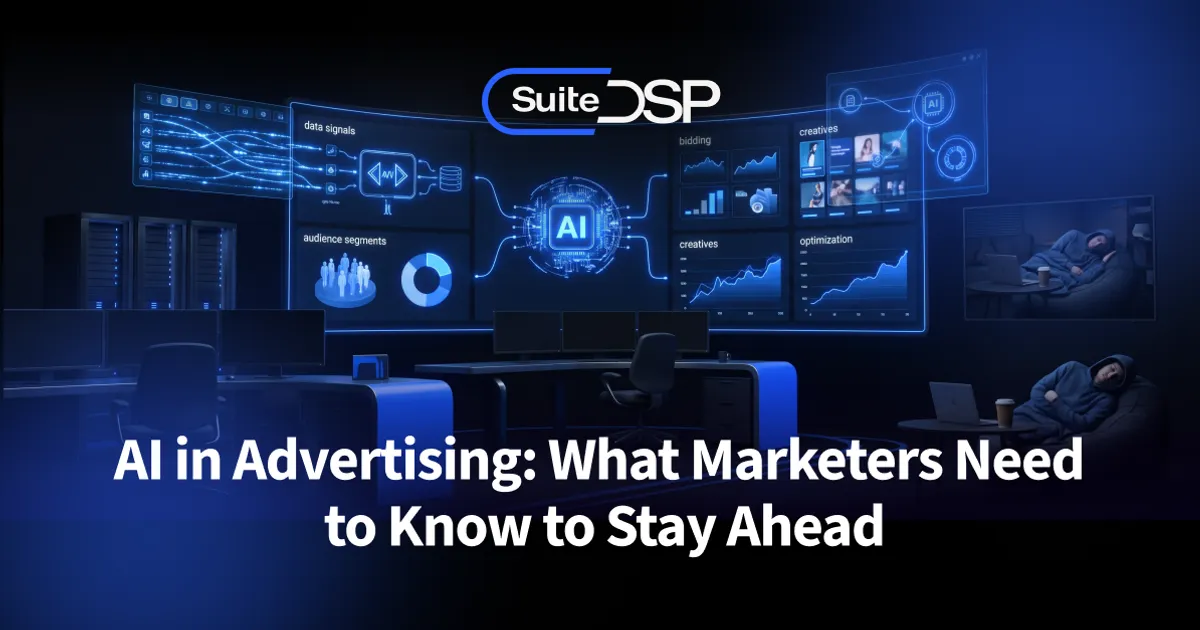
Even before a single ad appears onscreen, artificial intelligence is part of numerous decisions related to advertising.
From determining which impressions will be worth purchasing, what to bid for them, who are the target audiences, and how budgets are going to be allocated next – all of this involves the use of artificial intelligence. This is a golden chance for advertisers that goes beyond merely creating a buzz with headlines and visuals.
This is an opportunity to become part and parcel of the very fabric of modern-day advertising that connects the dots between data, media buying, and creative execution.
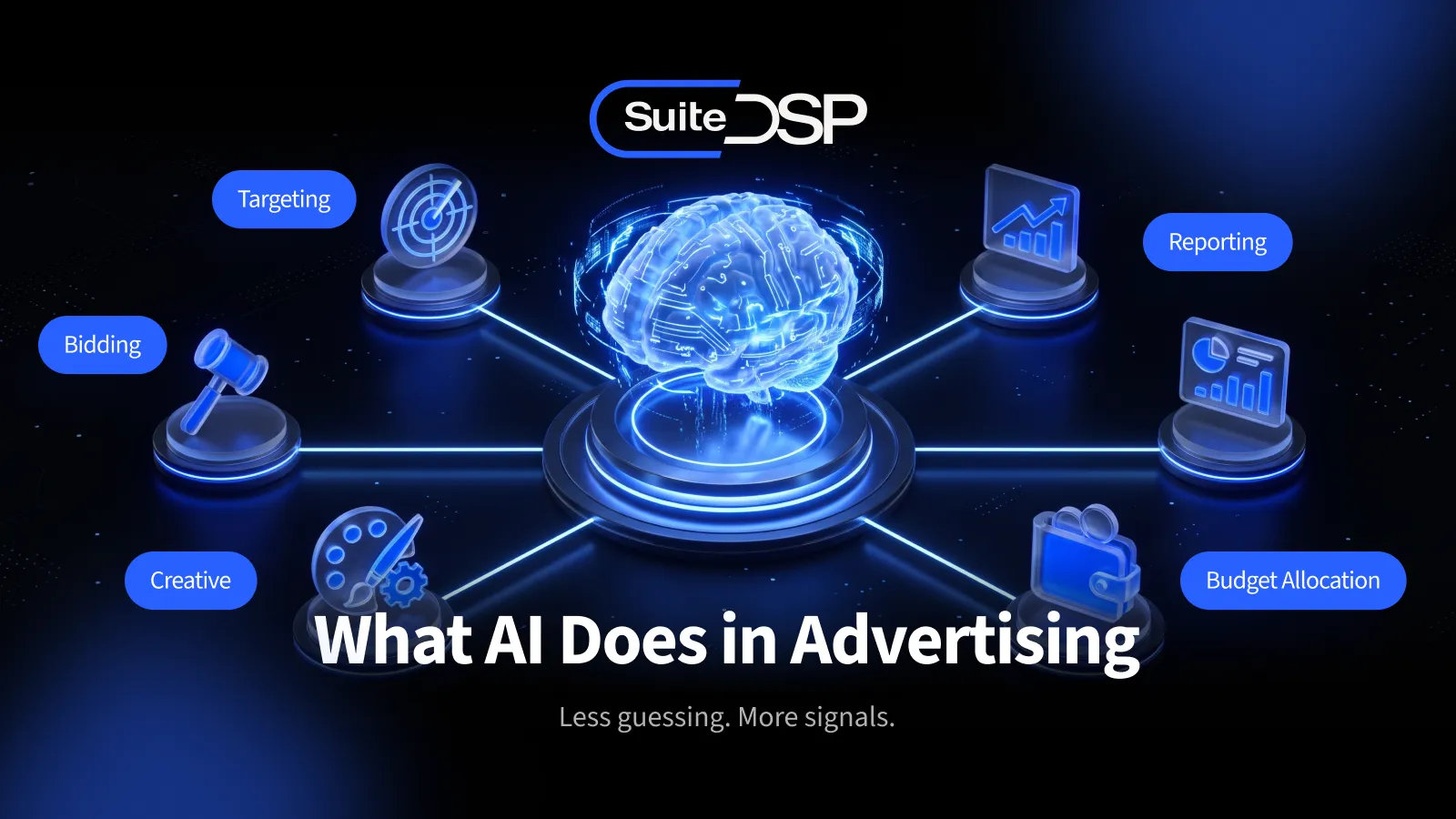
Artificial intelligence algorithms automate real-time bidding, contextual targeting, creative customization, and campaign budget allocation.
What Is AI in Advertising?
The workflow procedures involving conventional forms of advertising usually depend on reports, adjustments made manually, and assumptions concerning the audience. In contrast to conventional rule-based automation, AI can recognize patterns in big data sets and modify its predictions in light of new data.
Two technologies are particularly important:
In the Machine Learning (ML), the past marketing data, consumer signals, and conversion patterns have been utilized to identify the ad placement that will be successful.
Natural Language Processing (NLP) processes written texts, intent of searches, sentiment of searches, and contextual signals in order to target ads.
Computer Vision is yet another tool used in order to recognize objects, environment, and visual cues in pictures and videos.
When put together, all of these allow for evaluation of impression worth, prediction of likelihood of conversion, bid optimization, and finding appropriate placement opportunities on the fly.
Thus, a DSP based on artificial intelligence is able to determine the value of an impression in terms of campaign objectives and possible bids prior to participating in an auction. Obviously, AI usage in advertising is not limited to automated content production; media buying turns into a never-ending loop of predictions, actions, and optimizations.
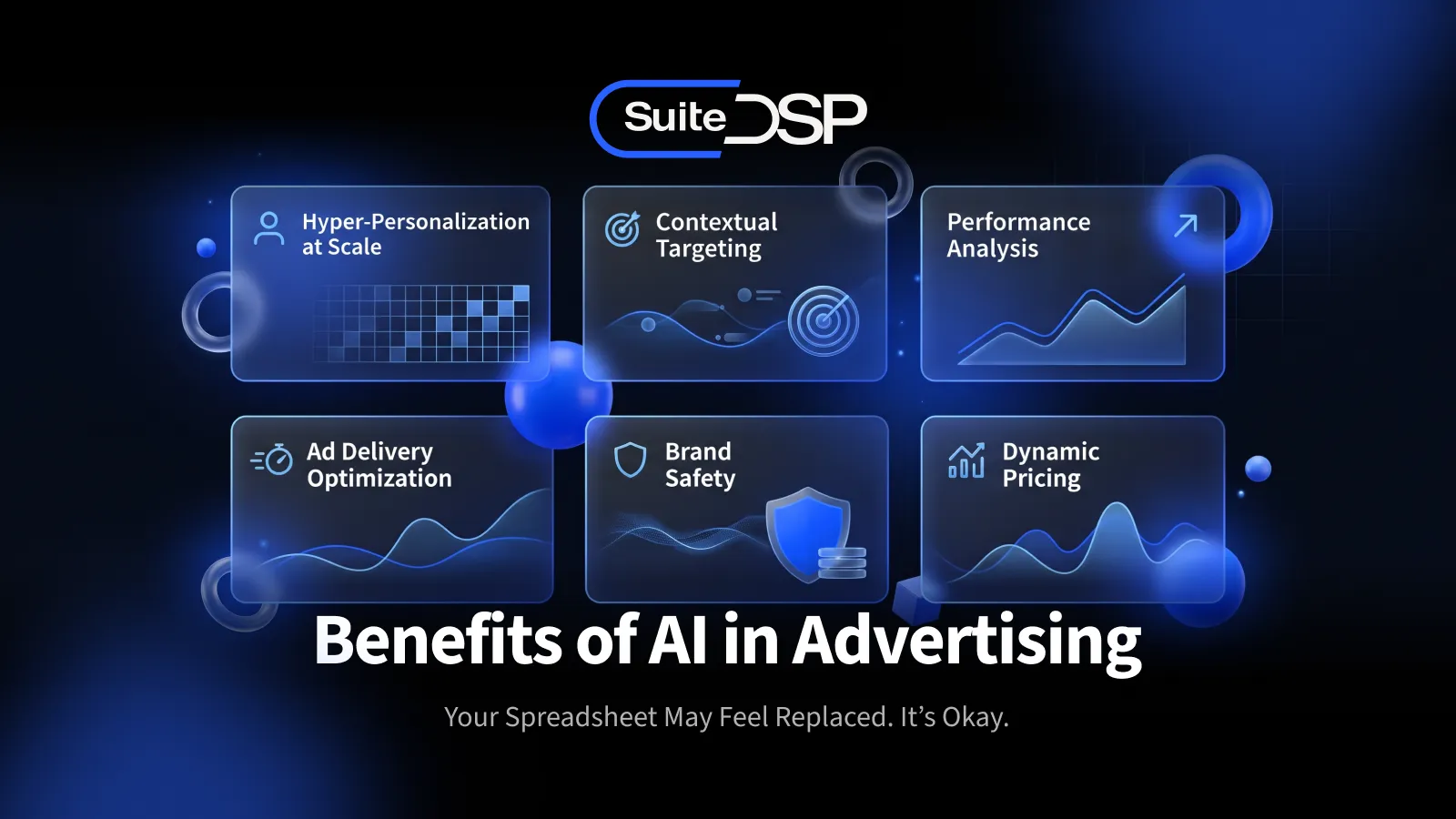
Integrating machine learning models into demand-side platforms optimizes bid pricing, brand safety protocols, and cross-channel delivery efficiency.
What Are the Benefits of AI in Advertising?
Processes of workflow that revolve around conventional advertising require reports, manual intervention, and assumptions regarding the audience. Artificial intelligence helps to evaluate performance and react to changing circumstances instantly. The commercial value of AI for advertising is associated with the improvement in decision quality, rather than a decrease in the workload of marketing specialists.
Hyper-Personalization at Scale
Think about such elements as planning, targeting, bidding, creative, reporting, and optimization. Try to determine those factors that can prove costly and/or unpredictable.
Regardless of how interested an audience may be in a product, each audience will respond differently to different messages. By virtue of the tools that use AI technology, you will be able to create various headlines, images, copy, and call-to-action for different audiences.
Contextual Targeting and Segmentation
With the diminishing accuracy of third-party identifiers, contextual intelligence plays a more important role. Contextual targeting is performed by using technology that is based on artificial intelligence and includes natural language processing and computer vision that enables analysis of the page, topic, image, and video content. It provides an opportunity for setting up the right environment without tracking the person.
Performance Analysis
Marketing applications for artificial intelligence let analyze the success of different kinds of campaigns targeting different audiences, types and regions. It allows spotting some tendencies that may be difficult to see in ordinary reports. Marketers won’t need to wait till the report of a week shows a decline of the conversion rate. They will learn about it earlier.
Predictive analytics can help in forecasting probable results and budgeting. This information still needs interpretation. The change in performance may be caused by seasonality, differences in attribution, or different audiences, and not the campaign itself.
Ad Delivery Optimisation
Machine learning models assist in managing pacing, frequencies, selection of placements, and optimization of the bid. Programmatic buying assists in bidding analysis and estimating the value of the impression that would be served.
Budget allocation to the media that give better results is possible. For a closer look at the technology behind these decisions, read SuiteDSP's guide to Real-Time Bidding in AI.
Advanced Brand Safety
Artificial intelligence can be used to identify unsuitable content prior to its use on an ad’s placement page.Tools like natural language processing, sentiment analysis, image recognition, and video classification can be used to identify any sensitive or offensive content.
On the other hand, advertisers could also employ these cues along with exclusions and inventory check for brand safety. All automated classifications cannot always be correct due to language, satire, news break, or cultural context.
Dynamic Pricing
There are also ways that AI can assist with dynamic pricing in two specific contexts. First, algorithms set bid prices based on the worth of impressions, competition, and objectives of campaigns. In the field of commerce, pricing strategies might suggest promotions based on various signals, including demand and inventories, among others.
While both are geared towards improving their economic performance, they have to adopt differing strategies for management. They have to keep in mind factors related to profit, fairness, legality, and trust, rather than focusing on maximizing conversion rates.
How Leading Brands Use Generative AI Advertising Today
As companies' marketing departments adopt generative AI solutions to create and customize creative materials for use on different platforms, an approved campaign idea will turn into display ads, social creatives, videos, and other localized versions. For example, a fashion retailer creating its seasonal promotional campaign would use generative AI to create its headlines, resize and localize the product messaging.
After that, the created assets get reviewed by humans and approved.
The more important opportunity lies in the ability to combine creative production with the performance of campaigns. Instead of creating multiple variants without any guidance, one can leverage performance data to understand what messages should be tested. This is how feedback can be taken on the creative strategy and the execution of the media plan.
It must be stated that any material generated by artificial intelligence needs to go through checks for accuracy, copyright compliance, and platform advertisement policies.
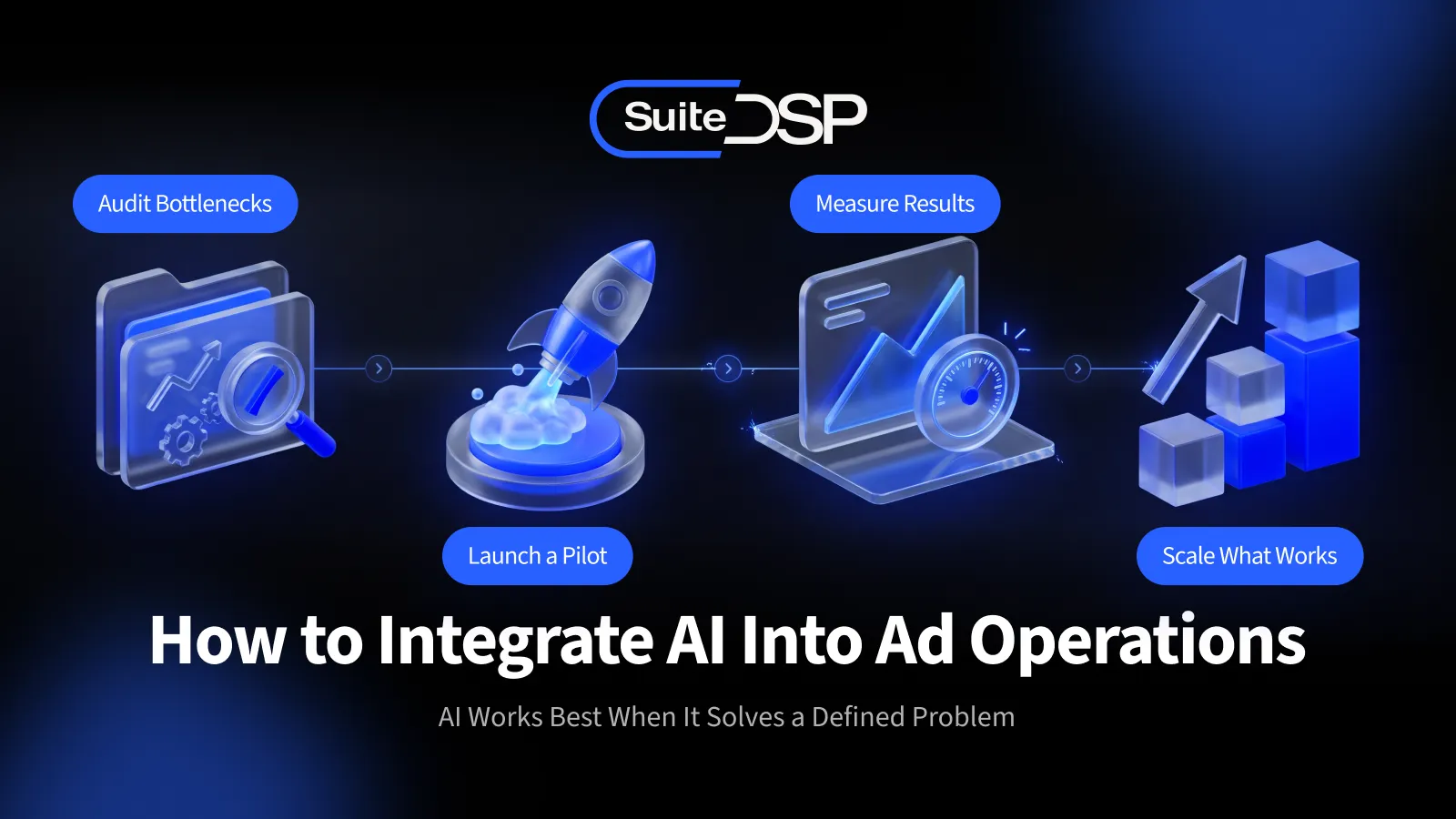
Structured operational framework guides marketing teams through auditing campaign bottlenecks, running pilot tests, and scaling automated media buying.
How to Integrate AI Into Your Ad Operations
Successful AI adoption begins with a defined operational problem and measurable success criteria.
1. Audit & Identify Bottlenecks
Look at categories like planning, targeting, bidding, creatives, reporting, and optimization. Determine what areas are expensive or hard to forecast. Examples may include manual bidding, poor reporting, repetitively adapting creatives, and bad budget management. Consider those aspects where forecasting and decision making will have an impact.
2. Launch a Pilot Project
Start with running the test campaign on a small scale with a small number of people or media. Use metrics to set up a benchmark and then measure the effectiveness of your AI campaign with the right control group.
Piloting this would mean either testing the predictive bidding strategy compared to the normal bidding strategy or the AI-created creatives against the ones that have been approved. Do not switch everything at once since identifying the winning and losing part would be difficult.
3. Define a Human-in-the-Loop Framework
Assign the roles before automating. Although the AI system may be used to make an offer, identify an anomaly, or create variations, it will be up to the human team to control the objectives, budget, claims, and criteria of branding.
4. Scale & Automate Media Buying
Once value has been demonstrated in the pilot, gradually expand the capability of AI through incremental improvements. Connect relevant data sources, harmonize the measurement process, and automate the optimization process.
Watch out for performance issues while scaling the campaign, especially when the new channel or market or target audience is being entered. Models used for the AI might require retraining under these changed circumstances.
The AI Advertising Tech Stack: How to Choose the Right Tools
The tech stack for an effective AI-powered advertising strategy must integrate data, decisions, campaigns, and measurements.
This is determined by each company but can involve the CRM platform, CDP, analytics tool, creative technologies, and the DSP. It does not mean that you should try to collect all the possible tools for artificial intelligence marketing. Instead, your task is to arrange a proper workflow without making it complicated.
Checklist for Evaluating AI Advertising Platforms
Evaluation criterion | Questions to ask |
Data integration | Can the platform connect with existing CRM, analytics, and first-party data systems? |
Algorithm transparency | Can marketers understand optimization goals, bidding controls, and performance reporting? |
Privacy and security | What controls govern data access, retention, consent, and processing? |
Media capabilities | Which formats, inventory sources, and targeting approaches are supported? |
Commercial scalability | How do platform fees, integration costs, and operational requirements change as spend increases? |
Advertisers should also examine data portability, reporting access, and contractual terms to reduce the risk of vendor lock-in.
Why Choose SuiteDSP
SuiteDSP provides media buying, campaigns management, targeting, and optimization within one advertising ecosystem. For marketing teams working with campaigns that operate across many channels and audiences, having one DSP can eliminate fragmented operations and make performance evaluation simpler.
AI-assisted bidding and optimization will be used by advertisers to make decisions based on the feedback from the campaigns and not through any manual actions. Contextual targeting and brand safety control can be effective in delivering relevant ads in privacy-friendly environment.
But then the real power comes from the link between these tools and the goals of the campaign. However, the true value is in the connection between all those tools and campaign objectives/measurement. For instance, an advertiser who works with display, video, and other channels needs to evaluate how those channels impact business goals instead of viewing every channel as a separate campaign. Explore why this matters in SuiteDSP's article on Omnichannel Advertising.
There cannot be any guarantees about the maximum return on ad spend from any advertising platform. It depends on data quality, campaign set-up, inventory, creatives, and market situation.
Measuring ROI: How to Calculate the True Value of AI in Ads
In order for the AI-based advertising strategy to be effective, the technological stack has to incorporate data, decision-making, campaign execution, and measurement.
It might differ from company to company, but the technological stack could contain the CRM system, CDP, analytics tools, technologies for creative and the DSP platform. The objective is not to collect all possible tools for using AI for marketing.
Checklist for AI Advertising Platforms Evaluation
Return on ad spend (ROAS)
Cost per acquisition (CPA)
Conversion rate
Revenue or contribution margin
Customer acquisition and retention
Campaign management costs
A basic return-on-investment calculation is:
AI ROI = (Incremental financial benefit − AI implementation and operating costs) / AI implementation and operating costs × 100%
For example, suppose an AI advertising pilot generates an estimated $30,000 in incremental contribution profit while the additional technology, integration, and operating costs total $10,000.
The resulting ROI is:
($30,000 − $10,000) / $10,000 × 100% = 200%
Measurement of true success involves conducting an experiment on a control group, proper allocation of resources, and accurate attribution.
Metrics of success will involve consideration of both the customer retention and the lifetime value of customers since conversion optimization might lead to poor acquisition decisions.
Challenges, Risks, and Ethics in AI Advertising
AI introduces new operational and reputational risks alongside its benefits.
Data privacy: Ad teams need to make sure that data used for training, targeting, and optimization is done on the right legal basis and complies with the relevant laws such as GDPR and US state laws including the CCPA.
Bias: If models are trained with incomplete or insufficient data, then they could be biased towards certain groups or create unfavorable results.
False information and misleading statements: With generative AI, we may have credible but false descriptions or statistical information.
The problems associated with copyright and the rights to intellectual property: Rights and allowed business usage of AI products will depend on the type of technology, content, contracts, and jurisdictions we are dealing with.
Brand safety: The system may not understand the context, and the generated message can contradict the core values of the brand.
To prevent any potential hazards, the organization must implement data governance, control the access to the data, authenticate claims in advertisements, evaluate AI-generated assets, and authorize decisions via human interaction.
Other measures include documenting changes in the model, setting of the campaign, and any critical automated decision made. Responsible AI governance is a necessity from the operations side as well.
Why Human Creativity Still Matters
AI can recognize trends in advertising effectiveness, but AI lacks the contextual experience of a brand’s history, its customer relationships, or its cultural significance that human marketers have. An algorithm may find that certain content generates more clicks. But the marketer needs to make sure that the content aligns with the brand’s overall strategic direction.
The optimal solution would be a synergy of both technology efficiency and human insight. In other words, AI will be responsible for doing all the work that requires computing power: analysis, tests, forecasts, and implementation. Creative marketing professionals come up with the strategy and its stories and set the priorities accordingly. This approach allows companies to become efficient without losing their authenticity and consistency.
The Future of AI Advertising
In the next step of AI for marketing, the workflow will become more autonomous in order to design campaigns. Instead of optimizing everything manually, the marketer will define the goals, budget, target group, and limitations, and the AI will then complete the task. Agentic AI will assist in planning campaigns, media activation, measuring the results of the campaign, and optimizing the campaigns throughout systems.
However, privacy needs, quality of data, transparency, and interoperability will continue being relevant constraints. The trends for AI in marketing will also include contextually smart AI, predictive analytics, and automation of testing for creatives.
As these skills get better, the role of the marketer will become strategic planning, experimenting, orchestrating creativity, and overseeing processes. It is not going to be an advantage just to be the first to adopt AI. The advantage will come from integrating AI into solid advertising operations.
Conclusion
The next stage in development of AI for marketing will definitely involve increasingly autonomous workflows of campaigns. Instead of optimizing all manually, the marketer can define goals, budget, target audience and constraints, and the AI will take care of everything else. Agentic AI will be capable of assisting with campaign planning, media activation, monitoring campaign performance, and cross-system optimization of campaigns.
However, constraints like privacy concerns, data quality, transparency and interoperability will continue remaining relevant.
The trends for AI in marketing will also be about contextually intelligent AI, predictive analytics and automation of creatives testing.
With the development of these capabilities, the role of the marketer will turn into strategic planning, experiments and orchestration of creativity and processes. It won’t be an advantage just to be the first to implement AI. The advantage will be achieved through integration of AI into a robust advertising operation.
FAQ
Is AI Going to Replace Advertising?
No. AI will transform the way advertising works, not make the process of advertising itself unnecessary or the people involved in advertising. AI will be able to automate bidding, analysis, and even some elements of creative process, but it won’t take place of human strategic thinking, branding, ethics, and knowledge of the target audience.
How Many Companies Use AI Advertising?
There is no single number as surveys about adoption rates of AI advertising use different definitions. Some use generative content tools, others incorporate predictive analytics and automated bidding into marketing automation. Whatever the numbers are, they should always be understood with regard to methodology of the survey, sample used, and publication year.
Which AI Is Best for Advertising?
Depending on what you're trying to achieve, there may be different options for you. If you're trying to generate content or create something creative, generative AI tools are for you. If your goal is programmatic advertising using AI, then you'll need AI-powered DSPs.