
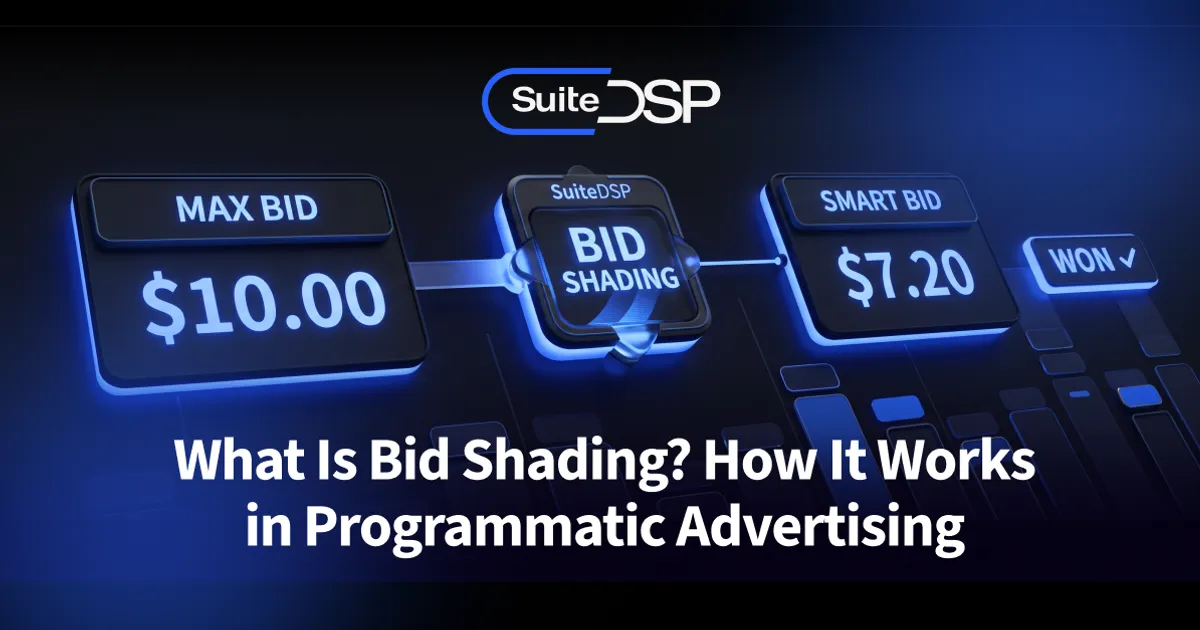
Suppose your DSP calculates that an impression is worth $12 CPM.
Does it actually need to bid $12?
Maybe. Maybe not.
That small difference is the reason bid shading exists.
Programmatic advertising operates through auctions happening at enormous speed. A DSP has milliseconds to assess an impression, decide whether it is worth buying, calculate a bid, and respond. But calculating the maximum value of an impression is only half the job.
The DSP also has to decide how much it really needs to bid to win.
Bid shading is designed to solve exactly that problem.
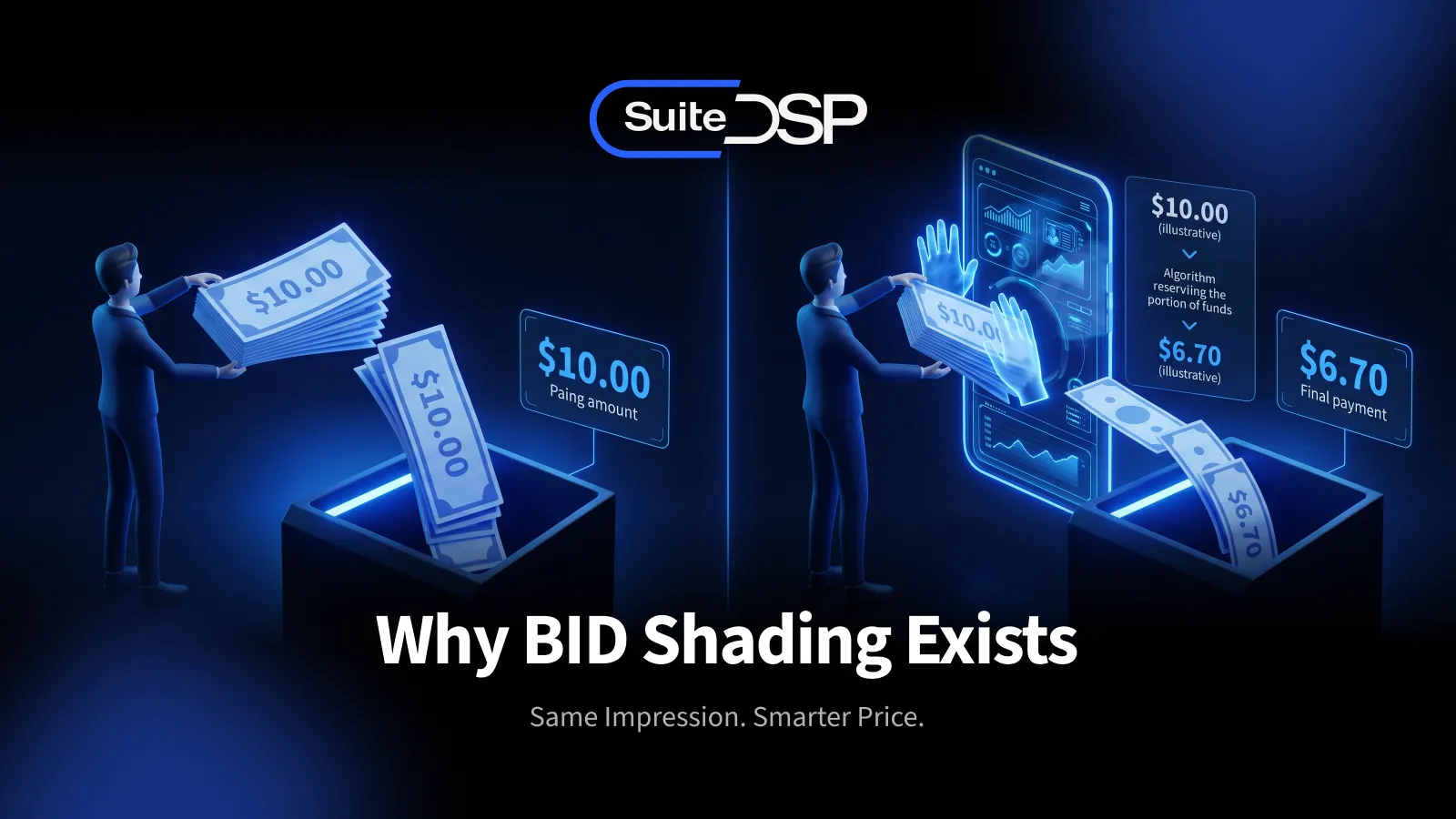
DSP bid shading algorithms reduce submitted bids from maximum valuation down to estimated auction clearing prices.
What Is Bid Shading?
Bid shading is a programmatic bidding technique used primarily in first-price auctions. Instead of submitting the full amount a buyer is willing to pay, the buying platform estimates a lower bid that still has a reasonable chance of winning.
The objective is simple: avoid paying more than necessary.
To understand why that matters, you first need to understand the auction.
Historically, much of programmatic advertising relied on second-price auctions. The highest bidder won, but generally paid an amount based on the second-highest bid rather than the full value of its own bid. As the industry shifted toward first-price auctions, that dynamic changed. In a first-price model, the winner generally pays its submitted bid. IAB
That created a new problem for buyers.
Bid too low and you lose impressions you wanted. Bid the full amount you're willing to pay every time and you can spend considerably more than necessary.
Bid shading sits between those two outcomes.

Demand-side platform engines analyze historical clearing prices and floor rates to predict optimal winning bid ranges.
How Does Bid Shading Work?
Imagine a DSP determines that an impression is worth up to $10 CPM to an advertiser.
Simply bidding $10 gives the buyer a strong position in the auction. But if similar impressions are usually won for around $7, paying the full $10 is inefficient.
A bid-shading system may instead submit something closer to $7.
If the bid wins, the advertiser gets the impression without paying the full maximum value it assigned to it. If the platform shades too aggressively, however, the advertiser may lose the auction.
That trade-off is the entire game.
Effective bid shading therefore isn't just about lowering bids. It is about estimating the price that offers an acceptable balance between cost and probability of winning.
And that estimate changes constantly.
Auction conditions can vary by publisher, placement, device, geography, format, time of day, audience, supply source and competitive pressure. Modern programmatic auctions themselves can also include mechanics beyond a textbook highest-bid-wins example. Google Ad Manager, for instance, says its auction evaluates the highest net bid and can account for the probability that an ad will successfully serve and generate a billable impression.
Real auctions are messy. Good bidding technology has to deal with that mess.
Why Did Bid Shading Become Important?
The move toward first-price auctions changed the economics of bidding.
Under a classic second-price model, buyers could bid close to their true valuation because winning did not necessarily mean paying that entire amount. In a first-price auction, the submitted price has a much more direct relationship with what the winner pays. IAB
Suddenly, bidding $15 instead of $11 wasn't merely a way to express a higher maximum willingness to pay. It could materially increase the cost of the impression.
That gave DSPs a reason to become much better at estimating clearing prices.
Bid shading emerged as one answer.
The important word here is estimating.
A DSP does not normally know every competing bid before submitting its own. If it did, bidding would be easy. Instead, the platform has to work with the information and historical patterns available to it and determine what bid makes sense for that particular opportunity.
This is where data and optimization quality become important.
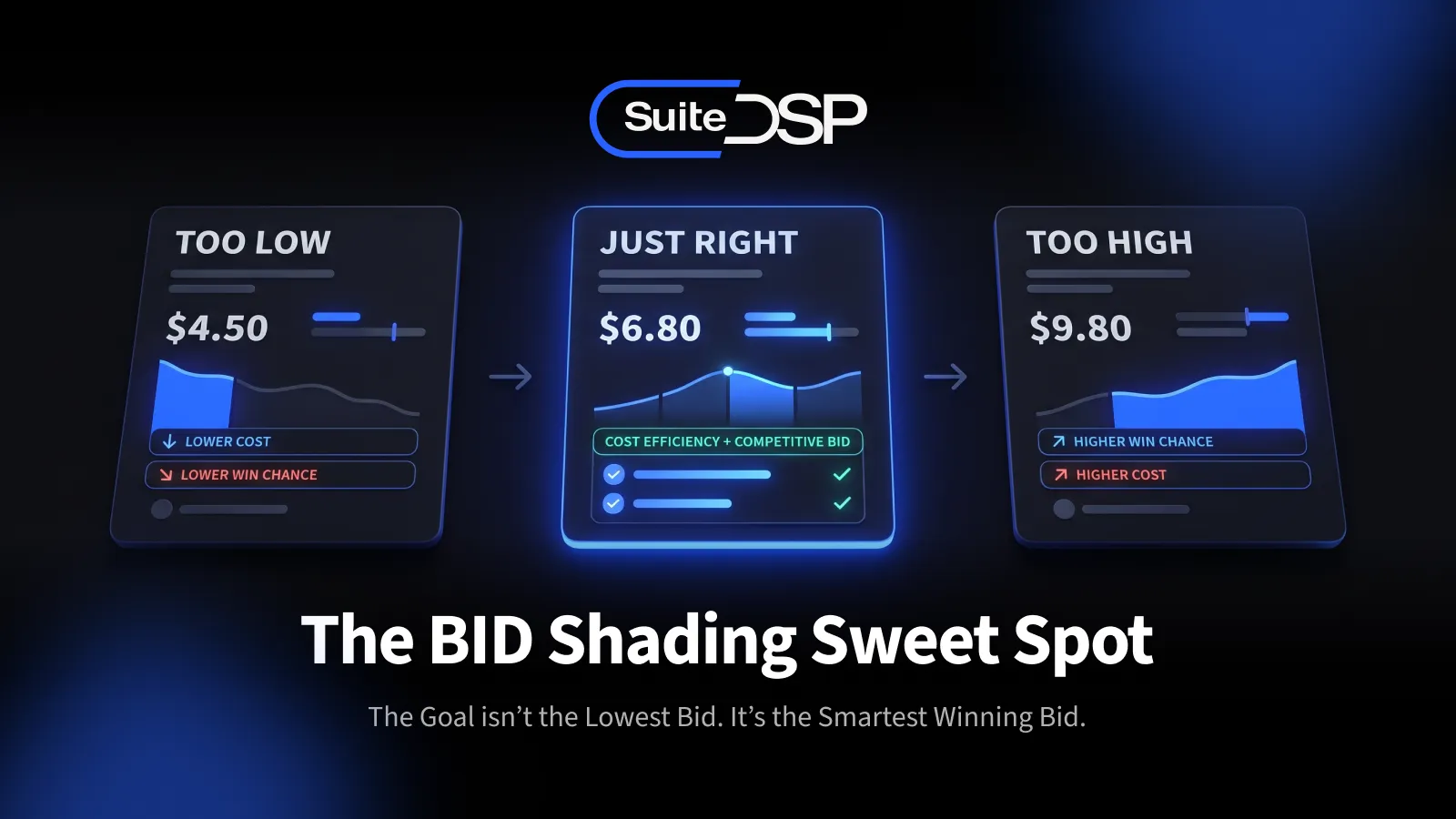
Balancing bid shading levels between underbidding win losses and overbidding budget waste achieves optimal media cost efficiency.
Bid Shading Is Not the Same as Bidding Low
This distinction sounds obvious, but it matters.
Lowering every bid by 20% isn't sophisticated bid shading. It is just lowering bids.
A useful bid-shading strategy has to respond to auction conditions.
Some impressions may have little competition. Others may be extremely competitive. A premium CTV placement during a high-demand period behaves differently from a standard display impression with abundant supply. Private auctions can also operate with set minimum floor prices, adding another variable that buyers have to account for.
A static discount ignores those differences.
A more sophisticated system evaluates the opportunity and adjusts accordingly. The ideal shaded bid is therefore not the cheapest bid possible. It is the lowest sensible bid that preserves an acceptable chance of winning.
That sounds like a minor distinction.
Across millions of auctions, it isn't.
How Bid Shading Can Improve Programmatic Efficiency
A few cents or a fraction of a CPM can look irrelevant when viewing one impression.
At campaign scale, those differences accumulate.
If a DSP repeatedly bids substantially above what is required to win, part of the media budget is being consumed without creating additional reach, conversions or impressions. The advertiser simply pays more for outcomes it might have achieved at a lower clearing price.
Bid shading attempts to reduce that gap.
Savings can potentially be reinvested into additional impressions, higher-value inventory or other parts of the campaign. More importantly, bidding becomes connected to the actual competitive environment rather than simply pushing maximum bids into every auction.
There is a limit, though.
Aggressive shading can hurt delivery. A platform that constantly tries to find the absolute cheapest possible win may reduce its win rate and miss valuable inventory.
Cheap media isn't automatically efficient media.
The real objective is to find the point where price, inventory quality, campaign goals and win probability make sense together.
What Does Bid Shading Mean for Advertisers?
Most advertisers will never manually calculate a shaded bid. The DSP handles that process.
That does not make the mechanics irrelevant.
Advertisers should understand how their buying platform approaches auction efficiency because bidding logic directly affects how quickly budgets are spent, which impressions are won and what advertisers ultimately pay for media.
This becomes especially important at scale.
SuiteDSP's own approach to DSP optimization reflects a broader reality of programmatic buying: optimization cannot be reduced to changing bids in isolation. Supply quality, historical performance, contextual signals, reporting and campaign objectives all influence media efficiency.
A low CPM with weak results is not a victory.
Neither is an excellent win rate achieved by consistently overpaying.
Good programmatic buying lives somewhere between the two.
Bid Shading and Real-Time Optimization
Programmatic advertising produces an enormous number of decisions.
That volume is exactly why automated bidding matters.
Every auction creates another data point. Which bids won? Which lost? How did pricing differ across supply sources? What happened to campaign performance afterward?
Over time, bidding systems can use these patterns to make more informed decisions about future opportunities.
This is also where the quality of the DSP becomes visible. Access to inventory is relatively easy to promise. Making economically sensible decisions across that inventory, auction after auction, is harder.
As we have discussed elsewhere on the SuiteDSP blog, modern DSP optimization increasingly depends on cleaner infrastructure, reliable signals and the ability to turn large volumes of auction data into practical decisions.
Bid shading is one small but important part of that machinery.
Bidding Gets Better When Targeting Gets Better
There is another side to this discussion.
Before a DSP decides how much to bid, it needs a good reason to bid at all.
Audience targeting helps determine which impressions deserve attention in the first place. Bid optimization then helps determine what those opportunities are worth and how aggressively the DSP should compete for them.
The two decisions are closely connected.
If you want to explore the targeting side of programmatic buying, read our previous article, What Is Audience Targeting in Programmatic Advertising? We break down how audience signals help advertisers reach more relevant users and make smarter media decisions.
Smarter Bidding Is About Paying the Right Price
Bid shading has a narrow job.
But it solves an expensive problem.
In first-price programmatic auctions, blindly submitting the maximum possible bid can create unnecessary media costs. Shading attempts to estimate a more efficient bid without sacrificing too much buying power.
Do it too cautiously and you may overpay.
Do it too aggressively and you stop winning.
The value lies in the calculation between those extremes.
That is why bidding technology matters more than the headline CPM. Strong programmatic performance comes from making thousands — and eventually millions — of small decisions well.
At SuiteDSP, we help advertisers combine intelligent bidding, cleaner supply paths, real-time optimization and omnichannel execution across CTV, video, native and display.
If you're spending more on programmatic but aren't sure whether your bidding strategy is actually making that budget work harder, it's worth looking under the hood.
Talk to the SuiteDSP team and see where your programmatic buying can become more efficient.