
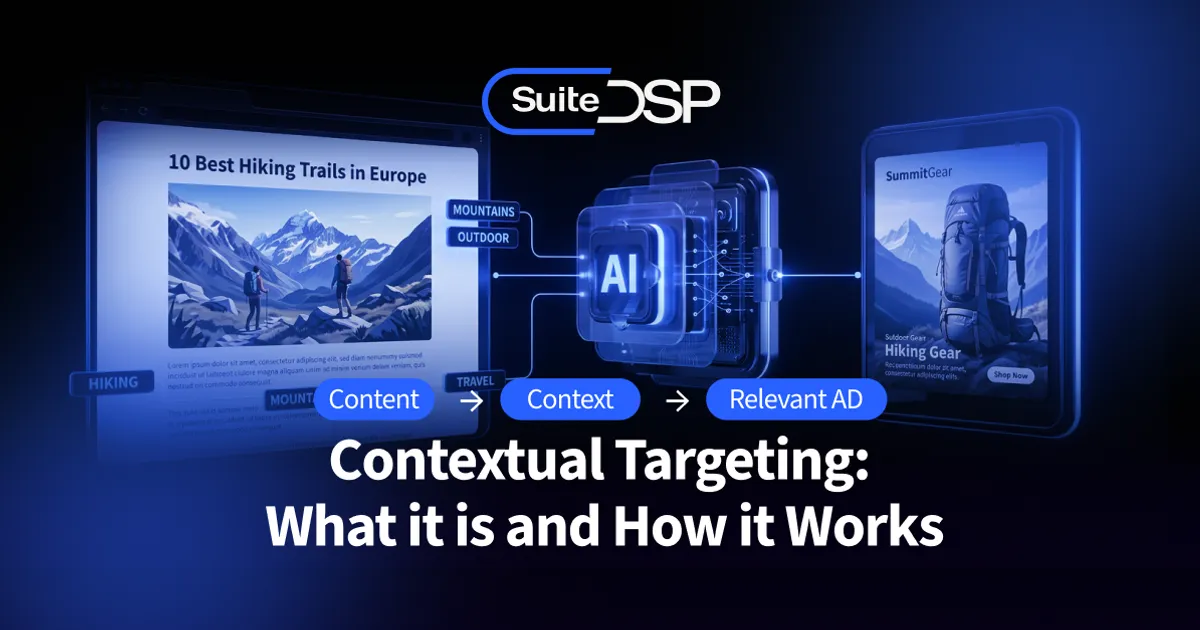
Digital advertising is undergoing its biggest privacy shift in decades. As third-party cookies fade out and regulations tighten around user data collection, programmatic marketers need effective ways to deliver relevant ads without relying on invasive tracking.
Enter contextual targeting—a privacy-first, highly efficient ad alignment strategy that places your marketing message directly where consumer interest is highest: right alongside relevant content.
In this guide, we break down what contextual ad targeting is, how AI-driven contextual engine analysis works under the hood, how it compares to traditional behavioral targeting, and how brands use SuiteDSP to drive high-converting, privacy-compliant campaigns.
What Is Contextual Targeting?
Contextual targeting is a programmatic media buying method that places ads on web pages, streaming environments, or mobile apps based on the page’s immediate content, keywords, and topic relevance—rather than tracking the user’s historical browsing behavior.
Instead of asking "Who is this user and where have they been before?", contextual targeting asks: "What is this user reading, watching, or engaged with right now?"
If a reader is on an article reviewing outdoor gear, a contextual ad placement automatically serves ads for hiking boots, camping equipment, or travel insurance. The ad feels natural, helpful, and non-intrusive because it aligns directly with the user’s current mindset.
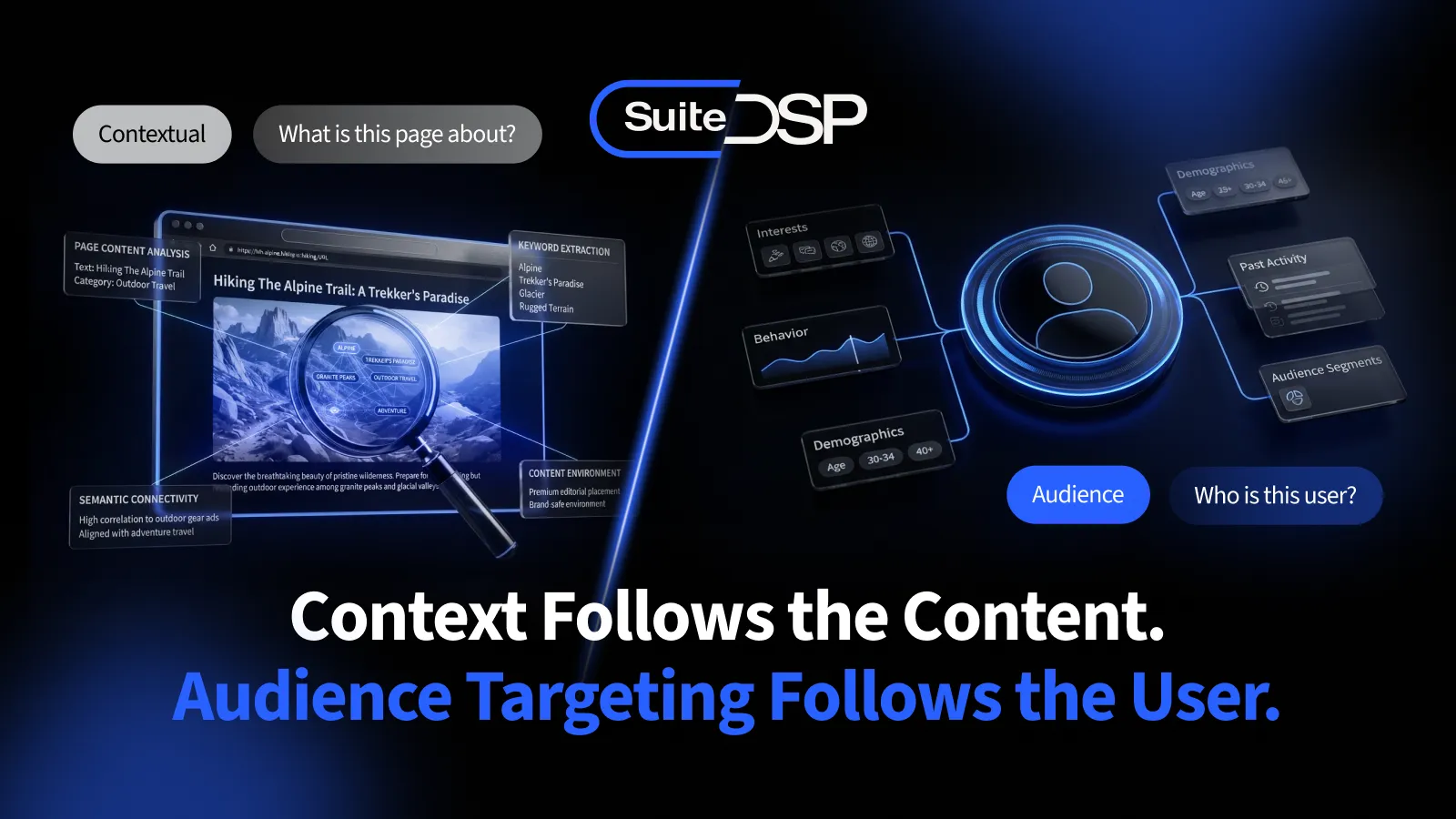
Contextual ad targeting analyzes live page content while audience targeting tracks historical user behavior across the web.
Contextual vs. Audience Targeting: What’s the Difference?
To understand why contextual advertising is experiencing a massive resurgence, it helps to compare it directly with classic behavioral ad targeting.
Feature | Contextual Targeting | Audience / Behavioral Targeting |
Primary Focus | Content Environment ("What is this page about?") | User Identity ("Who is this individual?") |
Data Dependency | Page text, keywords, metadata, sentiment, semantics | Third-party cookies, device IDs, past browsing history |
Privacy Compliance | 100% Privacy-safe (GDPR, CCPA, cookie-less) | Requires explicit user consent & tracking compliance |
Consumer Mindset | Aligns with immediate intent and active interest | Interruptive (targets past behavior, not current task) |
Setup Speed | Instant execution across programmatic SSPs | Complex audience segment building & data onboarding |
As the graphic illustrates: Context follows the content. Audience targeting follows the user. When third-party tracking breaks down, contextual targeting ensures your ad stays relevant without risking user privacy compliance.
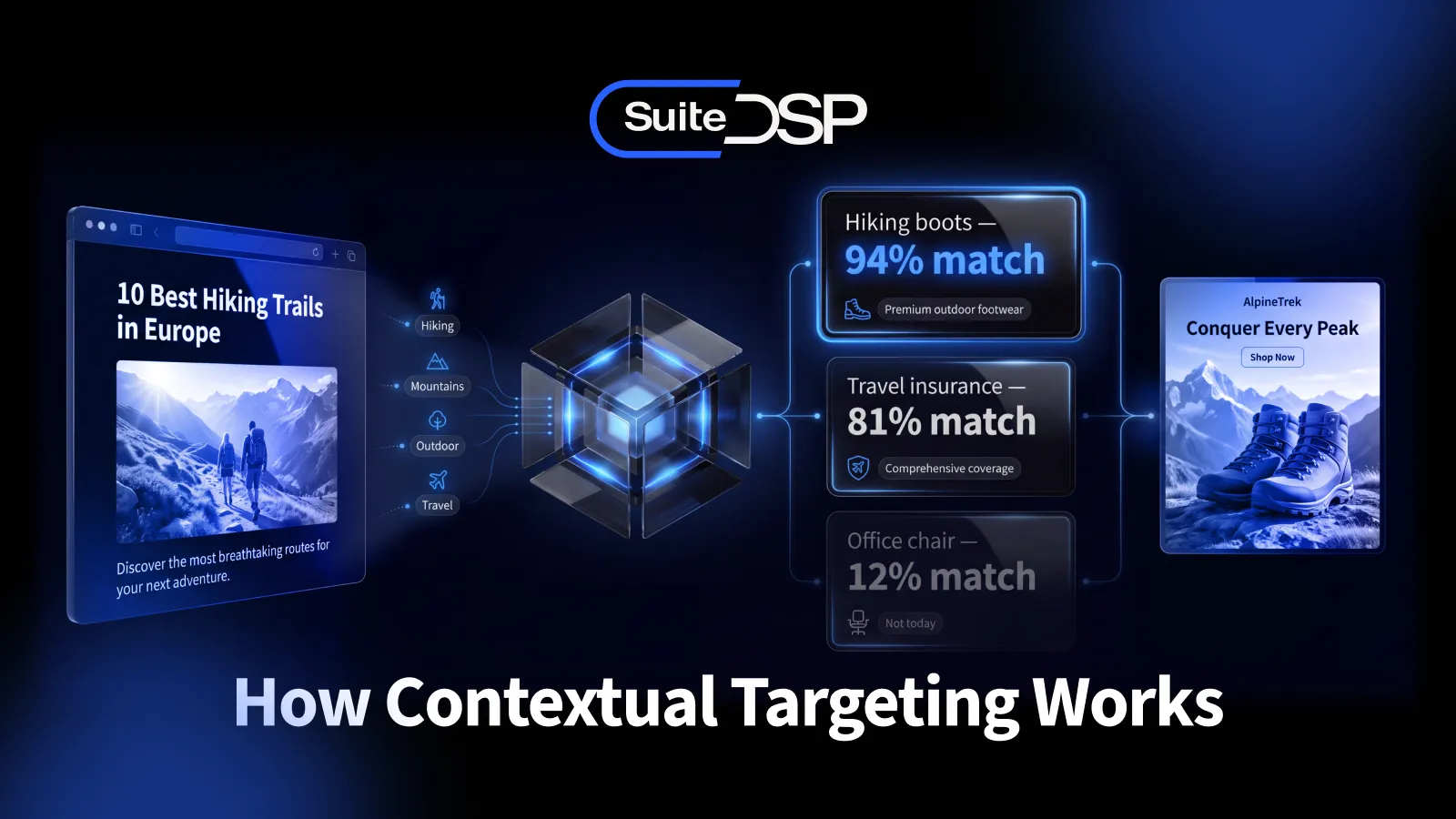
Natural Language Processing extracts page keywords and content themes to calculate precise product relevance match scores.
How Does Contextual Targeting Work? (Step-by-Step)
Modern contextual targeting has evolved far beyond basic keyword matching. Today’s AI-powered DSPs analyze full-page semantics, imagery, video content, and brand safety signals in real time.
Here is the step-by-step process of how a contextual programmatic bid occurs:
Step 1: Content Crawling & Analysis
When a user visits a webpage or streams content, the publisher’s page elements (URL, body text, headlines, meta tags, and images) are evaluated by a contextual analysis engine.
Step 2: Semantic & Keyword Extraction
Natural Language Processing (NLP) models extract core entities and sentiment. For example, on an article titled "10 Best Hiking Trails in Europe", the engine identifies keywords like Hiking, Mountains, Outdoor, and Travel.
Step 3: Algorithmic Relevance Matching
The platform compares candidate ads against the page’s extracted context signals to generate relevance match scores:
Hiking boots: 94% match (High correlation — Serve Ad)
Travel insurance: 81% match (Strong correlation — Secondary Option)
Office chair: 12% match (Irrelevant — Do Not Serve)
Step 4: Real-Time Bid & Ad Placement
The Demand-Side Platform (DSP) bids on the available ad slot in milliseconds, serving the highly relevant hiking ad directly to the consumer.
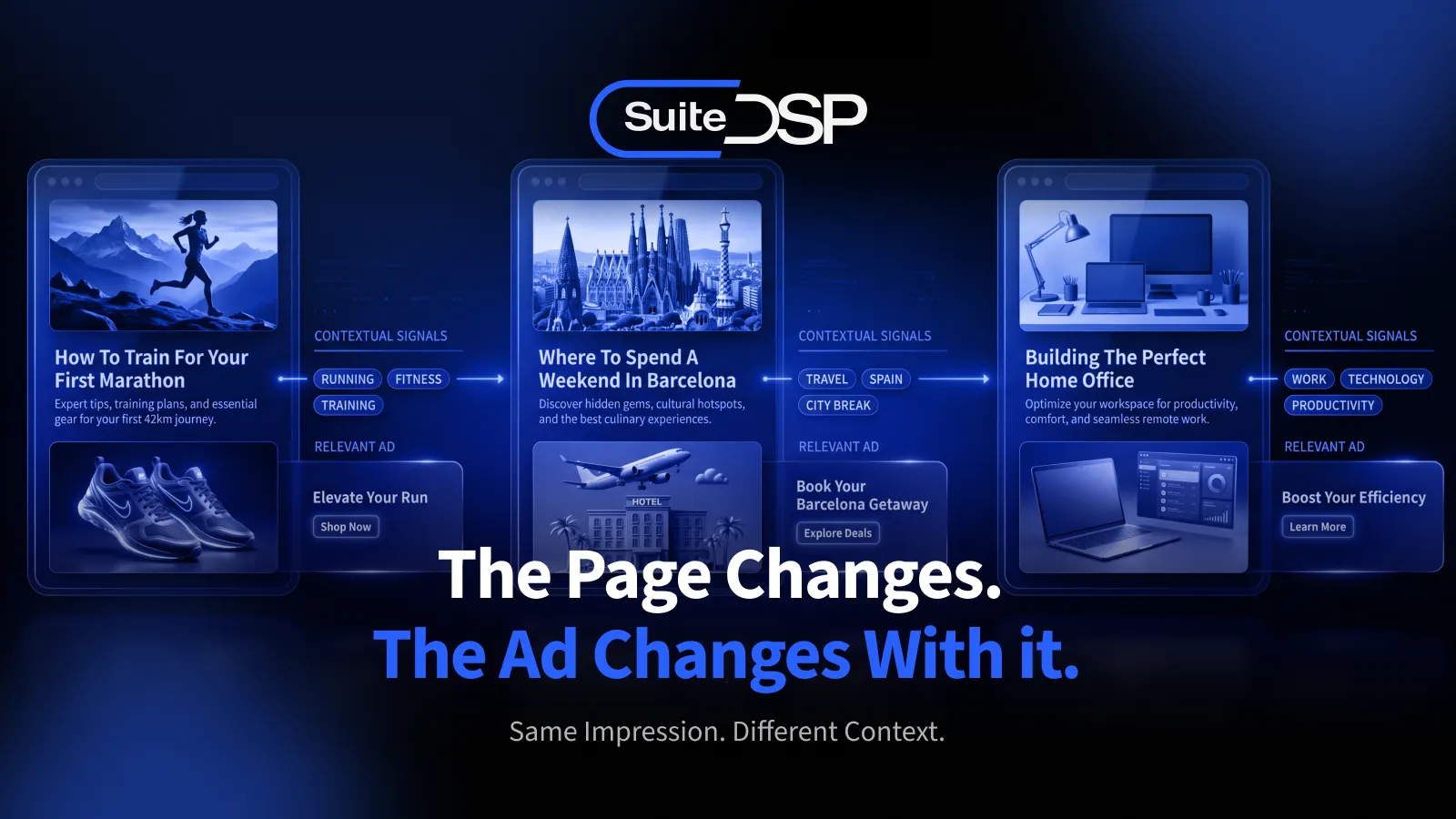
Dynamic ad placement automatically updates product creatives based on fitness, travel, or productivity editorial context.
Dynamic Contextual Relevance in Action
One of the greatest strengths of contextual ad placement is adaptability. Because bids are determined by live content rather than static user profiles, your ad campaign fluidly mirrors changing consumer contexts in real time.
Consider how ad delivery automatically shifts across different publisher environments:
Fitness Article: "How To Train For Your First Marathon" ➔ Serves running shoe & athletic apparel ads.
Travel Guide: "Where To Spend A Weekend In Barcelona" ➔ Serves hotel, flight, and city tour getaway deals.
Productivity Blog: "Building The Perfect Home Office" ➔ Serves ergonomic office setup & software efficiency ads.
The page changes. The ad changes with it. Same available impression opportunity, but infinitely better contextual relevance.
Key Benefits of Contextual Advertising for Brands
Relying on contextual signals delivers immediate strategic advantages for modern digital advertisers:
Future-Proof Cookie-less Reach: Works seamlessly across iOS Safari, Firefox, Chrome, Connected TV (CTV), and cookieless mobile web environments.
Higher User Intent & Ad Recall: Reaching users while they actively consume related content leads to stronger click-through rates (CTR) and higher purchase intent.
Built-in Brand Safety: Advanced contextual engines evaluate negative sentiment and unsafe topics (e.g., crime, tragic news) to prevent ads from appearing next to damaging content.
Lower Data Costs: Eliminates expensive third-party audience data fees, maximizing your working media budget.
Scale Your Contextual Campaigns with SuiteDSP
SuiteDSP gives advertisers, agencies, and media buyers full programmatic control over contextual, video, CTV, and display environments.
Through AI-powered bidding algorithms, transparent supply paths, and advanced contextual integrations, SuiteDSP ensures your ads reach consumers in the exact environments where they are ready to engage.
Whether you are looking to diversify away from third-party cookies or boost campaign efficiency across open exchanges and private marketplaces, SuiteDSP provides the infrastructure you need to drive measurable ROI.
Frequently Asked Questions (FAQ)
Does contextual targeting work on Connected TV (CTV)?
Yes! Contextual targeting on CTV uses publisher metadata, genre classification, show ratings, and video content signals to place ads in relevant streaming environments.
How is modern contextual targeting different from old keyword targeting?
Legacy keyword targeting only scanned for exact word matches (which often led to embarrassing brand-safety mistakes). Modern contextual AI uses Natural Language Processing (NLP) to understand page context, tone, sentiment, and visual elements.
Can I combine contextual targeting with other strategy layers?
Absolutely. Marketers frequently combine contextual environments with dayparting, geographic targeting, and device-level controls to sharpen campaign focus without relying on third-party cookies.