
Reaching millions of internet users is easy in modern digital marketing — but reaching the right consumer at the exact moment they are ready to buy requires precision.
Broad demographic reach often leads to wasted ad spend on disinterested users. Programmatic audience targeting solves this inefficiency by using real-time data signals to identify, segment, and bid on specific high-value audiences across web, mobile, Connected TV (CTV), and video inventory.
In this guide, we break down what programmatic audience targeting is, how demand-side platforms (DSPs) evaluate audience data, the core data types powering modern segments, and how SuiteDSP helps advertisers turn raw signals into high-converting campaigns.
What Is Audience Targeting?
Audience targeting in programmatic advertising is the strategy of delivering ad creatives to specific groups of consumers based on their behavioral signals, interest profiles, demographic attributes, geographic locations, or first-party relationship history — regardless of the specific website or app they are currently visiting.
Instead of buying ad space based purely on publisher content (such as buying an ad slot on a financial news site), audience targeting focuses on the individual user profile: "Does this specific user match our target customer persona?"
By shifting the focus from site-level placements to audience-level signals, programmatic buyers eliminate ad waste and deliver tailored messaging that resonates with active consumer intent.
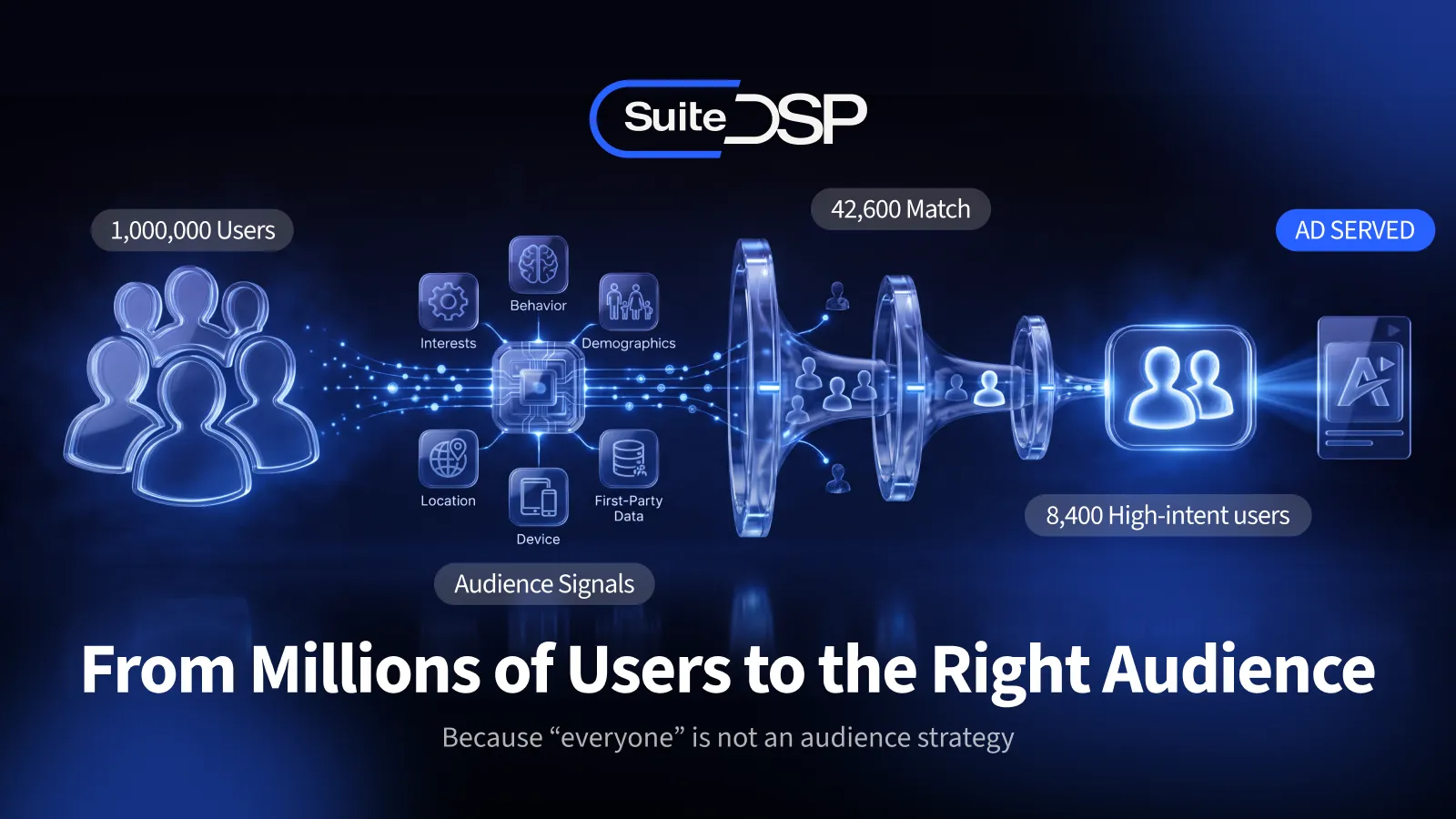
Demand-side platform filtering logic narrows millions of raw impression signals down to high-intent target audiences.
How Audience Targeting Works inside a DSP
To understand how audience targeting works in practice, consider the volume of impression opportunities flowing through real-time bidding (RTB) auctions every second.
When an available ad slot enters a Demand-Side Platform like SuiteDSP, algorithmic filtering converts massive user pools into actionable segments:
Broad Traffic Pool: A campaign starts with access to millions of available impressions across connected supply paths.
Data Signal Evaluation: The DSP instantly scans active data signals attached to the bid request — including location, device environment, behavioral history, and first-party segment memberships.
Algorithmic Funneling: Multi-layered filters eliminate disinterested users, reducing a 1,000,000-user pool down to a qualified match pool of 42,600 users.
High-Intent Bidding: The DSP identifies the core 8,400 high-intent users and places an automated, competitive bid to serve the ad creative.
This real-time filtering ensures ad budgets are spent exclusively on users who demonstrate high alignment with campaign goals.
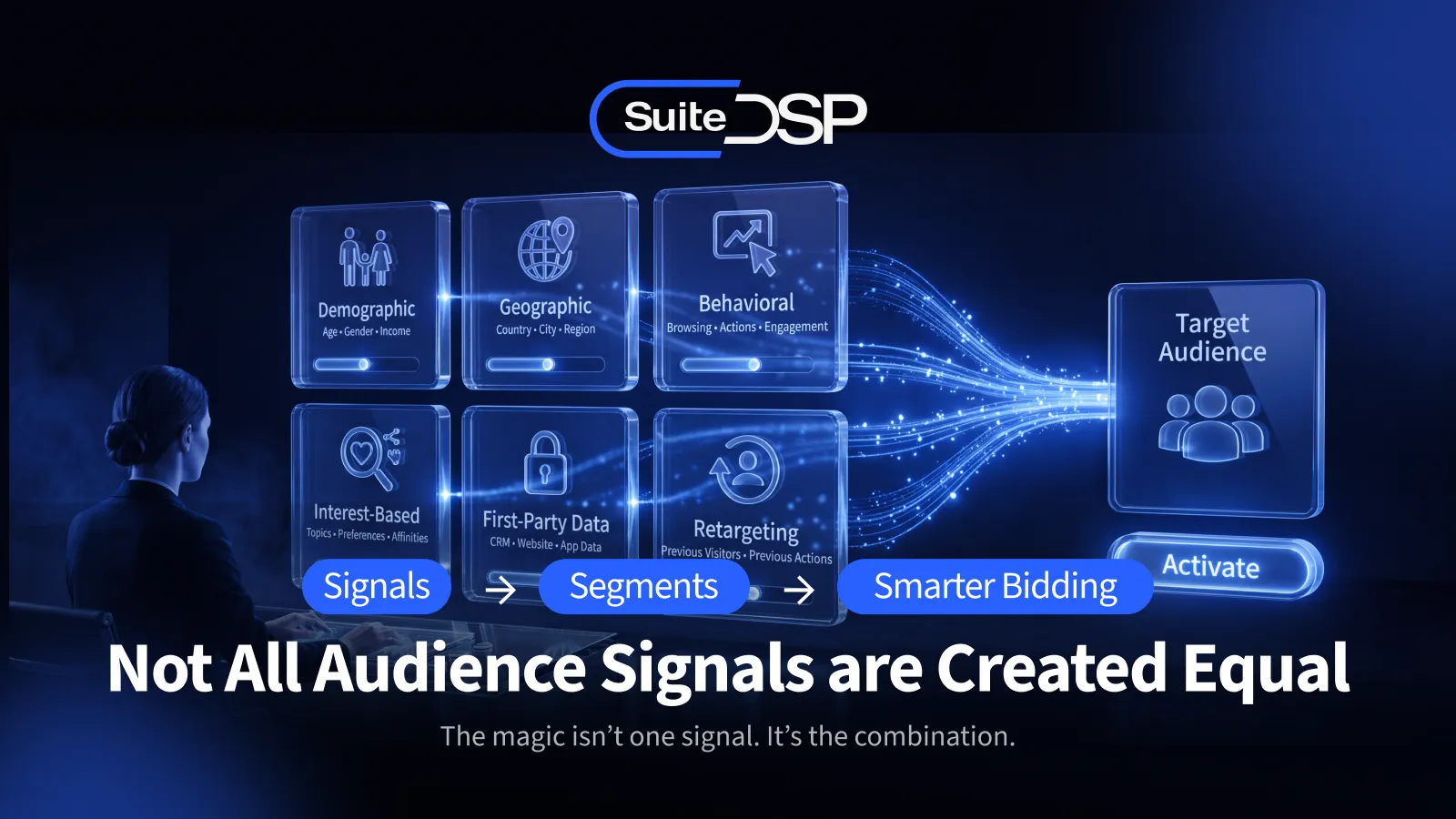
Combining demographic, geographic, behavioral, and first-party data signals optimizes programmatic bidding strategies.
The Main Types of Programmatic Audience Signals
Effective programmatic strategy relies on combining multiple data layers rather than depending on a single data point.
Audience Data Type | Signal Inputs | Primary Strategic Use Case |
Demographic | Age, gender, income bracket, household size | Establishing broad category alignment & brand positioning |
Geographic | Country, city, DMA, ZIP code, physical proximity | Localizing campaign reach & driving regional store foot-traffic |
Behavioral | Browsing history, app usage, content engagement | Reaching active researchers based on recent digital activity |
Interest-Based | Topic affinities, lifestyle preferences, active hobbies | Aligning brand messaging with consumer passions |
First-Party Data | CRM lists, website visitors, app subscriber data | Executing direct customer upsells & lookalike expansion |
Retargeting | Abandoned carts, past page views, past ad clicks | Re-engaging high-intent prospects to close conversions |
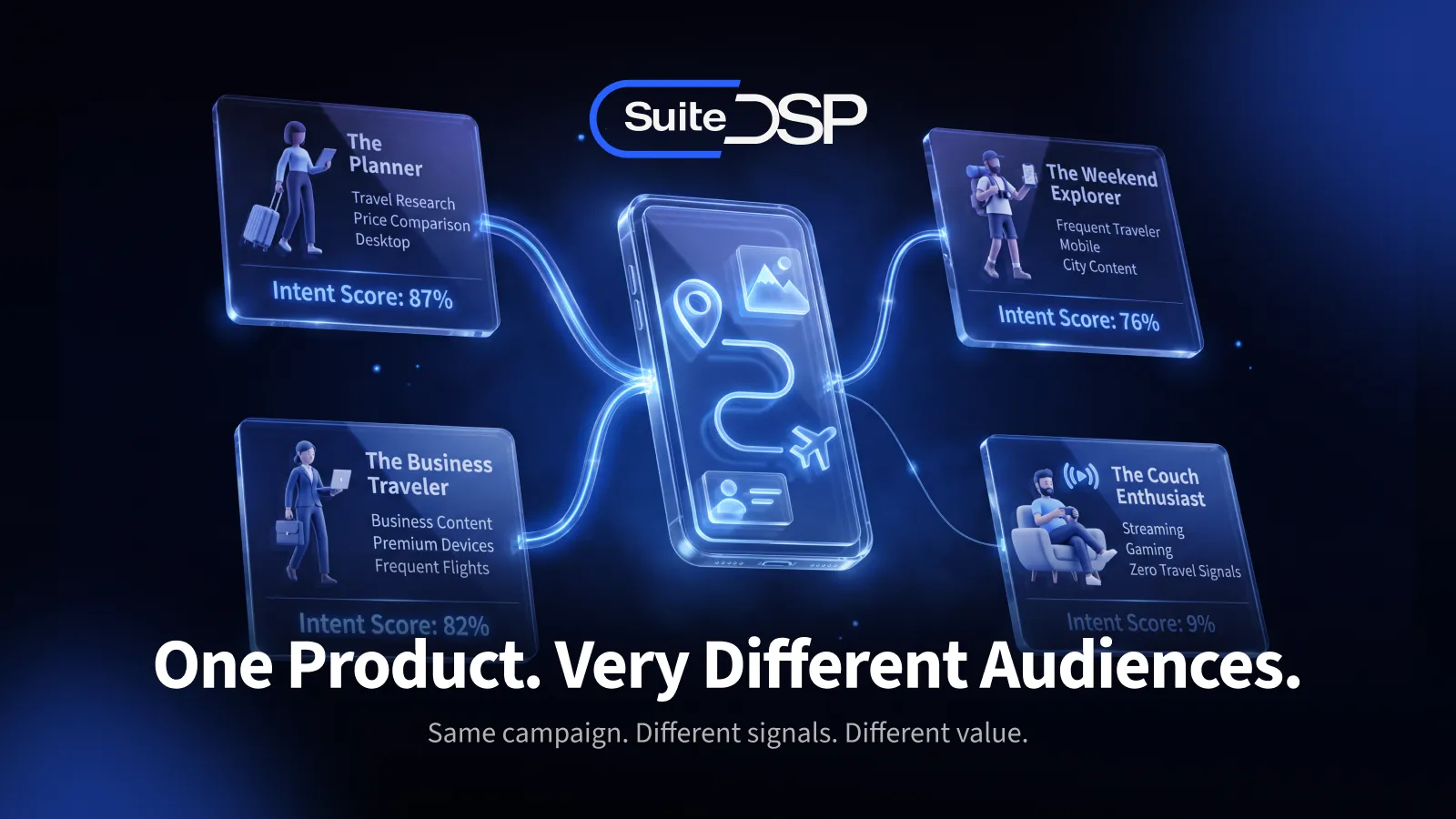
Segmenting consumer audiences by research behavior, mobile activity, and professional travel signals optimizes intent scoring.
One Product, Multiple Audience Personas
Because consumers interact with brands for different reasons, effective audience targeting segments campaigns into distinct intent profiles.
Consider a single travel campaign executed across four distinct audience segments:
The Planner (87% Intent Score): Desktop users actively conducting price comparisons and travel research.
The Business Traveler (82% Intent Score): High-frequency flight bookers engaging with premium business content.
The Weekend Explorer (76% Intent Score): Mobile-first travelers consuming city break and weekend getaway content.
The Couch Enthusiast (9% Intent Score): Streaming users displaying zero active travel intent signals (Bid Suppressed).
By assigning dynamic value scores to each persona, programmatic buyers can bid higher for top-tier intent profiles while suppressing bids on low-value traffic.
Key Benefits of Programmatic Audience Targeting
Reduced Media Waste: Directs capital toward qualified prospects rather than broadcasting to general audiences.
Dynamic Personalization: Enables creative tailored to specific user profiles, increasing click-through and conversion rates.
Cross-Device Continuity: Reaches target segments consistently across desktop, mobile, tablet, and Connected TV screens.
Scalable First-Party Activation: Allows brands to safely onboard CRM data to retain existing clients and model high-converting lookalike segments.
Activate High-Performing Audiences with SuiteDSP
SuiteDSP equips advertisers, agencies, and media buyers with the tools required to activate precise audience strategies across global ad inventory.
With real-time signal processing, seamless audience data onboarding, and flexible omnichannel bidding, SuiteDSP gives you complete control over how your campaigns identify, bid on, and convert high-value consumers.
Frequently Asked Questions (FAQ)
What is the difference between contextual targeting and audience targeting?
Contextual targeting places ads based on the webpage content (e.g., placing a boot ad on a hiking blog). Audience targeting places ads based on user profile signals, regardless of which website the user is currently viewing.
How does audience targeting work in a cookieless environment?
Modern audience targeting uses alternative identity solutions, including first-party data matching, contextual signals, IP-level geotargeting, and publisher ID graphs to identify relevant user groups without third-party cookies.
What is first-party audience data?
First-party data is information collected directly by your brand from your own audience — such as website visit history, app engagement, purchase logs, and CRM email subscriber lists.