
CTV and OTT appear next to each other so often that you could be forgiven for assuming they mean the same thing.
They don’t.
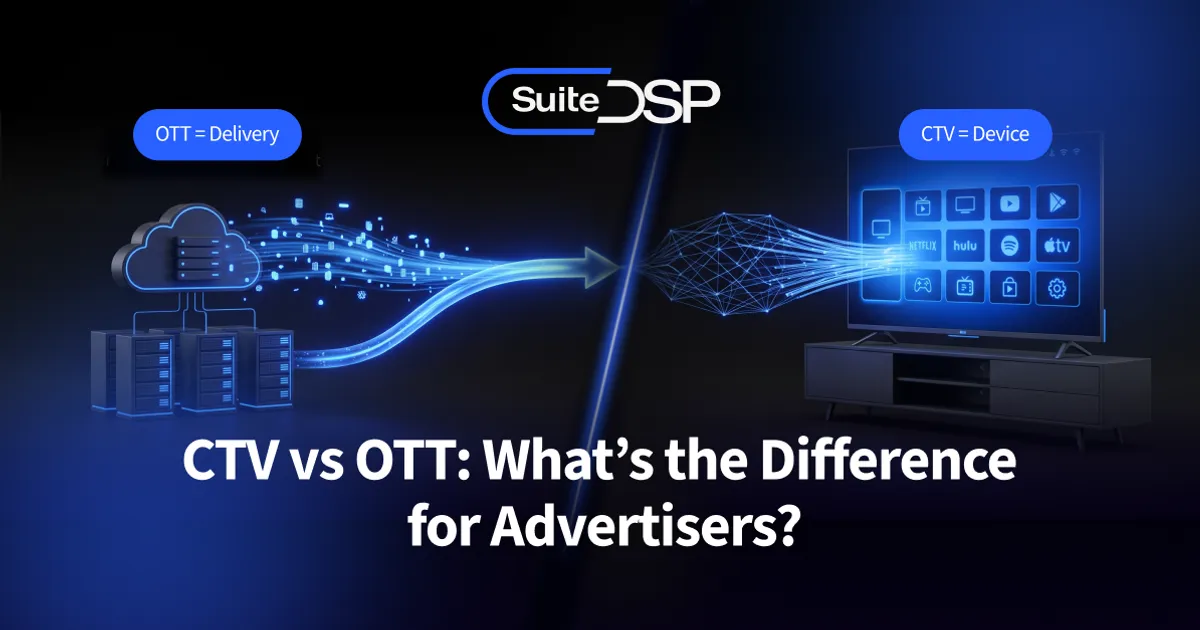
The difference is actually quite simple: OTT is about how content reaches the viewer. CTV is about where that content is watched.
That distinction might sound like adtech terminology for terminology’s sake. For advertisers, though, it affects campaign planning, inventory selection, targeting, creative, and measurement.
And once you see the distinction, the confusing part disappears pretty quickly.
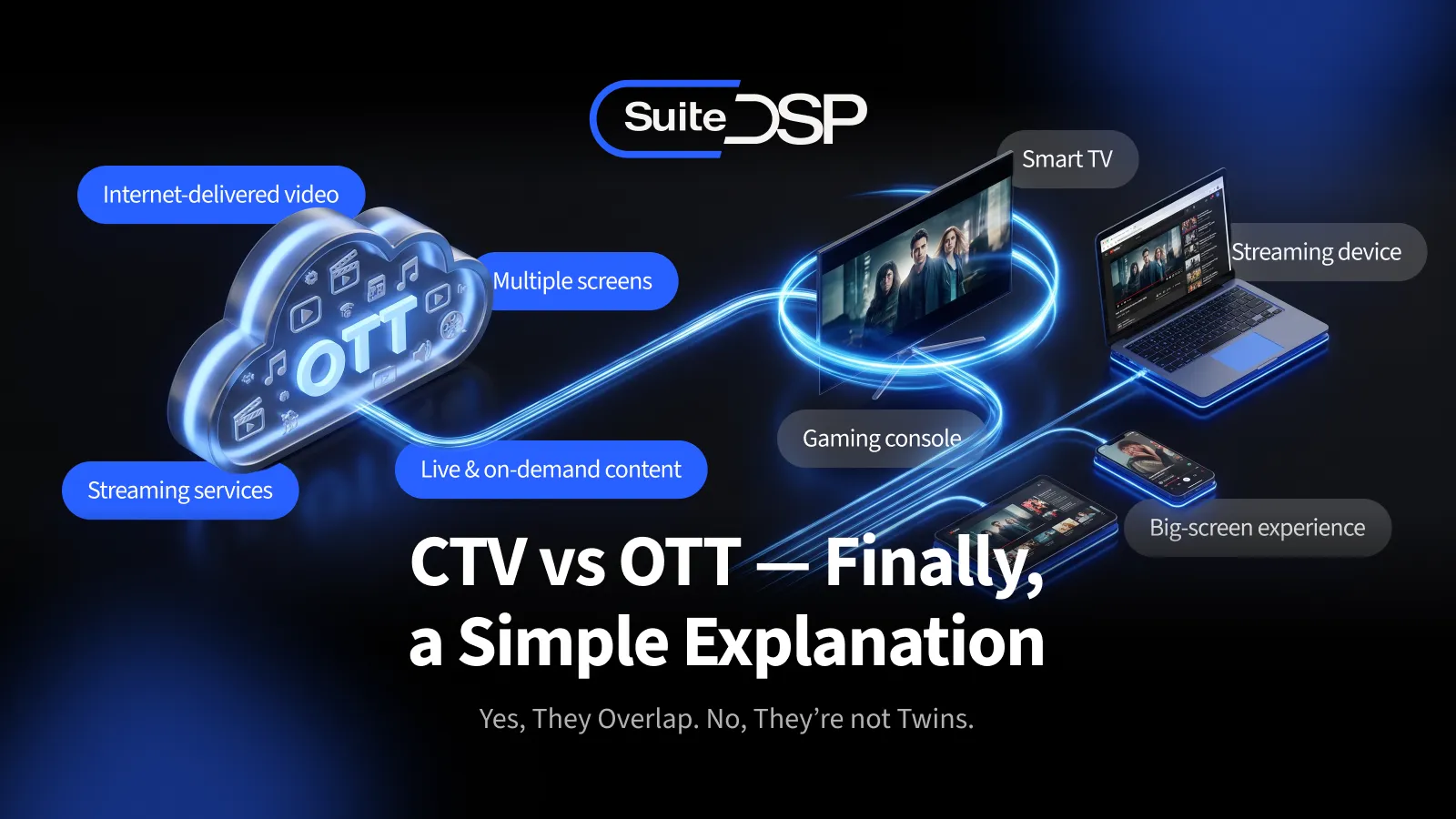
Cloud-based OTT internet video delivery connects across living room smart TVs, streaming media players, laptops, and mobile devices.
What Is OTT?
OTT stands for over-the-top.
The term describes video content delivered over the internet rather than through traditional broadcast, cable, or satellite distribution. IAB Tech Lab defines OTT around internet-delivered content and notes that it can be consumed across different screens.
That last part matters.
OTT is not necessarily television.
Someone streaming a show through an app on a smart TV is consuming OTT content. Someone watching that same service on a tablet or laptop is also consuming OTT content. The delivery method remains internet streaming even though the screen changes.
This is why treating “OTT” as another name for “TV advertising” creates problems. OTT describes the delivery of content, not one specific device.
What Is CTV?
CTV stands for Connected TV.
Here, the device is the point.
CTV refers to television screens that can access internet-delivered content, either directly or through another connected device. That includes smart TVs as well as TVs connected through streaming devices and game consoles. IAB Tech Lab draws the line quite clearly: CTV is specifically about internet-connected television devices and excludes mobile and desktop screens.
So if a viewer streams a program on a smart TV, that experience can be both OTT and CTV.
If they watch the same program on a smartphone, it is still OTT — but it is not CTV.
That is the easiest way to remember the difference.
CTV vs OTT: Content vs Screen
The terminology becomes much easier when you stop treating CTV and OTT as competing categories.
They describe different parts of the same viewing experience.
OTT tells us how the content is delivered. CTV tells us the type of screen on which it is consumed.
IAB Tech Lab reiterated this distinction in 2026, describing OTT as content delivery over IP while CTV describes consumption on connected television devices. The organization also noted that the industry has increasingly centered its commercial discussions on CTV, while OTT remains the underlying delivery concept.
For advertisers, this isn't just semantics.
Imagine a streaming service available on smart TVs, smartphones, tablets, and browsers. Buying “OTT inventory” without looking deeper can describe several very different viewing environments.
Buying CTV inventory narrows the context. The advertiser is specifically trying to reach someone watching through a television screen.
And a 55-inch television across the living room is not the same advertising environment as a phone held 30 centimeters from someone's face.
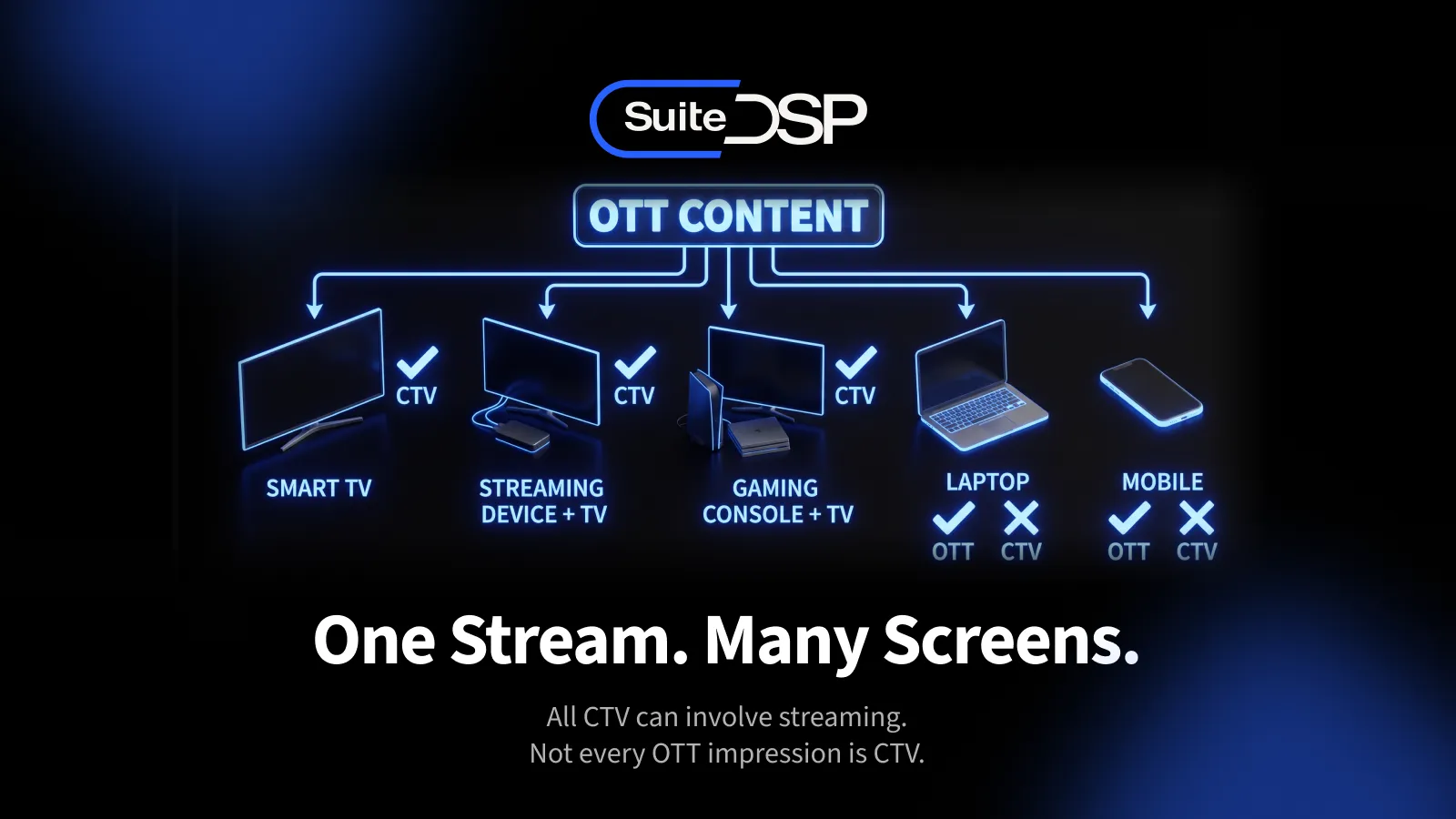
Device classification maps OTT streaming content across big-screen CTV devices versus mobile and laptop screens.
Why Does the Difference Matter for Advertisers?
Because the screen changes the experience.
CTV combines characteristics marketers already understand from television with capabilities associated with digital advertising. Ads appear in a large-screen, video-first environment, while programmatic infrastructure can support automated buying and digital targeting.
IAB Tech Lab describes CTV as bringing traditional television buying closer to the flexibility of digital real-time bidding.
That creates a different set of campaign considerations.
A CTV campaign may be built around household reach, premium video inventory, large-screen creative and incremental reach alongside linear television. A broader OTT strategy can follow streaming audiences across multiple internet-connected devices.
Neither is automatically the better option.
The right definition depends on what the advertiser is actually trying to buy.
CTV Is Becoming More Than a Pre-Roll Video Ad
One reason the terminology matters even more now is that CTV advertising itself is changing.
The old mental model was simple: stream a TV show, get a commercial break, watch a video ad.
That still exists. But it is far from the whole market.
IAB Tech Lab's updated CTV Ad Portfolio now covers formats including Pause Ads, Menu Ads, Screensaver Ads and In-Scene Ads. Some appear around content rather than interrupting it. Others live inside the TV or streaming interface itself.
This is a meaningful shift.
The television screen is becoming a digital advertising environment with its own formats rather than simply another place to run a standard video file.
For brands, that creates more creative options. For buyers, it also creates another reason to understand exactly what inventory a platform labels as CTV.
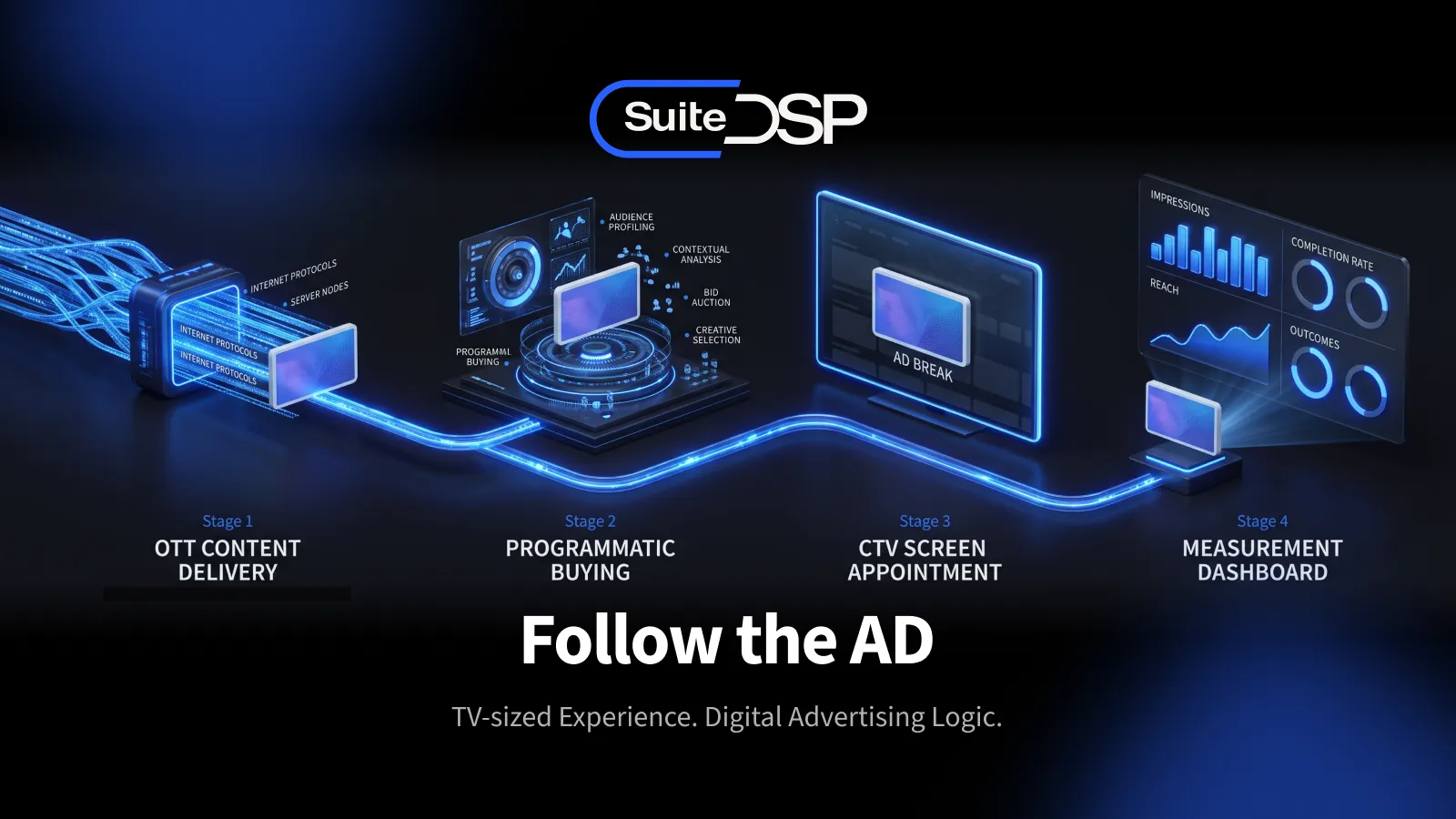
Programmatic video ad supply path links OTT content delivery through real-time DSP bidding to big-screen CTV measurements.
What About Targeting and Measurement?
CTV offers advertisers digital targeting possibilities that traditional linear TV was not built around.
Programmatic buyers can use available audience, contextual, geographic and campaign signals to make more selective media decisions rather than broadcasting the same message across an entire audience. But measurement is not automatically simple just because the media is digital.
CTV has its own technical realities.
App identification, device signals, ad verification, supply transparency and cross-device measurement all affect how campaigns are bought and evaluated. IAB Tech Lab's current programmatic CTV guidance addresses areas including OM SDK measurement, app-ads.txt, content taxonomy, audience taxonomy and interactive ad standards.
This is something advertisers occasionally learn the hard way: a streaming impression is not automatically a transparent impression.
The buying platform and supply path still matter.
CTV and OTT in Programmatic Advertising
For programmatic buyers, the practical question should therefore be more specific than “Do you offer OTT?”
What inventory is actually available? Which devices does it run on? Is it genuinely CTV? How is the app or content identified? What supply path is involved? How are impressions measured?
Those questions reveal far more than the label on a media plan.
Accurate device information is particularly important because misclassification has historically been a problem in CTV. Inaccurate device reporting can make buyers question campaign validity and complicate targeting, creative delivery, analytics and measurement.
The industry knows this is an issue. In 2026, IAB and IAB Tech Lab have continued work on more consistent video classifications precisely because streaming, CTV, online video and newer formats have outgrown some older definitions.
The label matters. The signals underneath it matter more.
From the Right Screen to the Right Bid
Knowing whether you're buying CTV or broader OTT inventory solves one part of the programmatic puzzle.
Then comes price.
Every impression still has to be evaluated, bid on and won at a price that makes sense for the campaign. That is where bidding mechanics become important.
In our previous article, What Is Bid Shading? How It Works in Programmatic Advertising, we explain how bid shading works in first-price auctions and why simply bidding more is not the same as bidding well.
If you're building a CTV or omnichannel programmatic strategy, it is a useful next read.
CTV vs OTT: The Difference Is Simple. The Buying Isn't.
OTT describes internet-delivered content.
CTV describes the connected television environment where content is watched.
There is plenty of overlap, which is exactly why the terms became blurred in the first place. But for advertisers, being precise helps clarify what inventory they are buying, which screens they are reaching and how campaigns should be measured.
The bigger lesson is straightforward.
Don't buy the acronym. Buy the actual media environment.
At SuiteDSP, we help advertisers plan and execute programmatic campaigns across CTV, video, display and native from one DSP environment. If you want to understand where your streaming budget is going, improve CTV execution or build a more connected omnichannel strategy, our team can help.
Talk to the SuiteDSP team and let's turn your media plan into a buying strategy that makes sense beyond the dashboard.