

Election campaigns operate within short timelines, rapidly changing media conditions, and intense competition for audience attention. As more campaign activity moves online, digital advertising for political campaigns increasingly depends on programmatic technology to manage media buying across multiple channels efficiently.
In essence, a political DSP is basically a demand-side platform that helps to strategize, purchase, optimize, and analyze digital advertising in relation to elections. Instead of going for separate purchasing systems for each channel, media buyers can adopt programmatic system capabilities to synchronize budgeting, inventories, bidding, and campaign performance through one platform.
The following article details the working of political programmatic advertising, what buyers need to take into account when choosing technology, and the benefits of omnichannel activation, real-time optimization, transparency, and supply chain efficiency.
Why Election Season Is a Stress Test for Programmatic Media Buying
Election cycles impose unique challenges for the entire digital advertising industry. There could be various players, ranging from political campaigns to advocacy groups and commercial advertisers, who would vie for the same premium inventory if the election activity happens to be concentrated in one particular market.
Increased demand translates into higher CPM and competition in programmatic buys. In contrast, election campaigns have a rigid schedule of activities that cannot be postponed or transferred to any other month, like for example, voting day never changes even if inventory becomes more expensive.
At the same time, media buying itself is becoming more complicated and fragmented, as there could be various channels such as display, native, video, CTV and others.
For a DSP for elections, therefore, reach alone is not enough. Buyers need control over:
budget allocation and pacing;
inventory and supply paths;
bid strategy;
channel performance;
campaign reporting;
optimization throughout the campaign.
When timelines become compressed, delays in identifying inefficient placements or reallocating spend can have a greater impact on overall campaign performance.

A low CPM measures the cost of impressions, not their quality. Media buyers can assess inventory alongside viewability, engagement and campaign outcomes.
How to Buy Political Advertising Programmatically
Buying political advertising programmatically follows the same fundamental workflow as other DSP-based media buying.
Campaign objectives, budgets, key performance indicators, timelines, and audiences must be established by the advertiser or agency initially. Campaigns can target general awareness in a population, audience engagement with the campaign, or audiences in relevant geographic regions, among other things. Depending on campaign objectives, advertising may also be used to communicate issues that affect particular communities or broader society.
Next, media buyers select the channels and inventory they want to access. A political ad buying platform can provide access to multiple programmatic environments without requiring buyers to negotiate every impression directly with individual publishers.
The teams then set the bids and begin their campaigns. In each opportunity of real-time bidding, the DSP analyzes the signals and decides whether the impression matches the campaign setup and how much to bid.
As soon as things start rolling, the buyers keep track of their deliveries, spending, placement, pace, and performance. The process of automated bidding is able to react to changes in auctions at all times.
This combination of planning, activation, automated bidding, measurement, and optimization is what makes political programmatic advertising particularly useful when campaign conditions change quickly.
What to Look for in a DSP for Election Campaigns
Not every DSP provides the same level of control, even when several platforms offer access to similar types of media.
When comparing a DSP for political campaigns, agencies, programmatic traders, and campaign media teams should evaluate several areas.
Omnichannel inventory. Buyers should be able to activate relevant formats without rebuilding campaign workflows across separate platforms.
Campaign management. Budgeting, pacing, targeting configuration, and campaign monitoring should be manageable from a consistent interface.
Real-time optimization. The platform should be capable of responding to performance signals while campaigns are live.
Reporting and transparency. Media teams need enough visibility to understand where spend is going and which placements, channels, and supply sources contribute to performance.
Supply path efficiency. Multiple intermediaries and duplicated routes to the same inventory can reduce efficiency.
AI capabilities. Machine learning can help evaluate large volumes of bid opportunities and performance data faster than manual campaign management alone.
A capable political advertising DSP should therefore be evaluated on working media efficiency, transparency, operational control, and performance—not simply on whether it can generate a low CPM.
Omnichannel Political Advertising: One Campaign Across Multiple Screens
Audiences no longer consume political information through a single screen. Voters may watch streaming content on connected TVs, browse news on mobile devices, and encounter campaign messaging across multiple digital environments before deciding how to vote.
That makes omnichannel execution increasingly important for digital advertising for political campaigns.
Campaigns can use different environments for different roles:
CTV can provide high-attention reach in premium streaming environments.
Video can communicate more complex campaign messages through sight, sound, and motion.
Display can provide scalable reach across websites and devices.
Native can place advertising within content-oriented environments.
Mobile helps maintain reach across the devices people use throughout the day.
Managing these channels through one political campaign advertising platform can reduce duplicated setup work and make performance easier to compare.
Instead of maintaining separate budgets and reports across disconnected tools, buyers can work from a more unified view of campaign delivery.

SuiteDSP brings multiple advertising formats into a unified workflow for campaign activation, optimization and reporting.
Managing Political Ad Spend When CPMs Increase
Election advertising demand can intensify competition for inventory, particularly as voting day approaches. Higher auction pressure may increase CPMs, but simply searching for the cheapest impressions is not necessarily the best response.
A lower CPM does not automatically mean more efficient media.
Low-cost inventory may generate weaker viewability, engagement, completion rates, or other campaign outcomes. Conversely, higher-cost inventory may provide stronger performance when it reaches the campaign's intended audience in a higher-quality environment.
Media teams therefore need to consider cost together with placement quality and campaign results.
Real-time optimization can help by responding to market changes while campaigns are active. Bids may be adjusted based on live performance, while budgets can be shifted away from weaker inventory or channels and toward opportunities producing better results.
For an election advertising DSP, this ability becomes especially valuable near campaign deadlines, when there is limited time to identify inefficiency and make corrections manually.
Supply Path Optimization for Political Programmatic Advertising
Programmatic inventory can sometimes be available through multiple exchanges, resellers, and intermediaries. In some cases, buyers may encounter duplicated auctions for effectively the same advertising opportunity.
Supply Path Optimization, or SPO, is the process of evaluating these routes and prioritizing more efficient paths to inventory.
The objective is not simply to remove every intermediary. Instead, SPO helps buyers understand how inventory reaches the DSP and identify routes that provide stronger combinations of quality, transparency, cost, and performance.
For political media buying, supply path efficiency matters because unnecessary layers can reduce the proportion of a campaign budget that reaches actual media.
An SPO-focused approach can help:
reduce duplicated supply paths;
improve visibility into inventory sources;
limit unnecessary reselling;
improve cost control;
make programmatic buying more transparent.
During high-demand election periods, these efficiencies can become particularly important because auction costs may already be elevated.
Real-Time Optimization and AI in Election Campaigns
Election campaigns often cannot wait several days before responding to performance changes. Media teams may need to evaluate delivery and make decisions within hours.
AI-driven optimization can support this process by continuously analyzing campaign signals at scale.
A DSP can evaluate information such as supply quality, contextual signals, historical performance, engagement probability, inventory performance, and campaign pacing. Based on those signals, optimization technology can adjust bids, reduce spending on lower-value impressions, or redistribute budgets.
AI does not remove the campaign manager from the process. Instead, it can reduce the amount of manual analysis required to identify patterns across thousands or millions of programmatic opportunities.
This is particularly relevant to political programmatic advertising, where campaign timelines are fixed and inefficient spending late in the cycle may be difficult to recover.
Real-time decision-making gives advertisers greater ability to react while there is still time to change the outcome of the media plan.
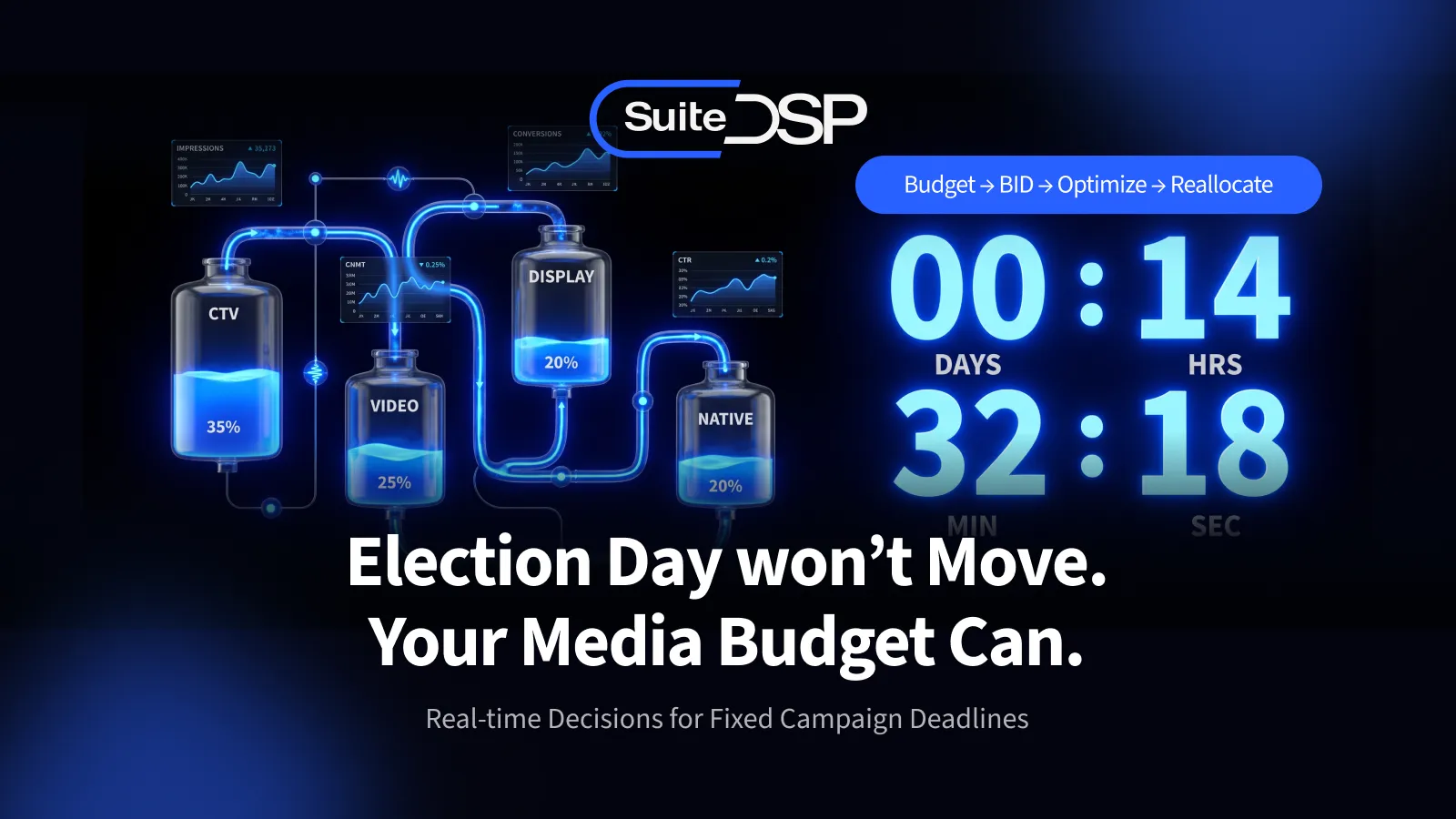
Real-time bidding and performance monitoring allow media teams to review spending and adjust budget allocation within fixed campaign timelines.
Transparency and Reporting in Political Media Buying
Large campaign budgets deployed over short periods make transparency essential.
Media buyers need to understand not only how much was spent, but also where that money went, what inventory was purchased, how different channels performed, and which placements contributed to campaign results.
Placement-level reporting can help teams identify strong and weak inventory rather than relying only on aggregated campaign averages.
Cross-channel reporting is equally important. If CTV, video, display, native, and mobile activity are purchased through separate systems, campaign teams may need to combine multiple datasets manually before they can understand overall performance.
Unified reporting reduces this fragmentation.
For agencies managing spending on behalf of a candidate, campaign, or political organization, clearer reporting can also simplify communication with internal stakeholders by providing a more consistent view of campaign delivery and media performance.
How SuiteDSP Supports Programmatic Political Campaigns
SuiteDSP is not positioned as a dedicated political advertising product. Instead, its existing programmatic infrastructure can support media buyers operating campaigns that require omnichannel activation, real-time optimization, efficient supply paths, and transparent reporting.
SuiteDSP offers a single workflow for planning, activating, optimizing, and analyzing programmatic campaigns.
Media buyers can set audience targeting, budgets, and KPIs prior to the activation of inventory in different environments such as CTV, video, native, display, mobile ads and other formats.
The real-time bidding platform considers bid opportunities as they appear, and the machine learning optimization evaluates the signals about supply quality, user environment, performance history, and chances of interaction in real-time.
SuiteDSP also applies an SPO-driven approach to inventory. By prioritizing cleaner and more efficient supply paths, the platform is designed to reduce unnecessary intermediaries and duplicated routes before optimization begins.
Reporting brings activity together across channels with placement-level visibility, helping buyers understand where budgets are being allocated and how different inventory performs.
For election media teams, the central advantage is therefore not a specialized political feature set. It is the ability to manage complex programmatic activity through one environment instead of creating separate workflows for every channel.
Political DSP vs. Fragmented Media Buying
An election campaign can technically purchase digital media through multiple individual platforms. However, fragmentation creates additional operational work.
With disconnected platforms, teams may need to:
configure campaigns repeatedly;
manage separate channel budgets;
compare incompatible reports;
optimize each environment independently;
track different inventory and supply relationships;
manually determine how total spend is distributed.
A unified political campaign advertising platform creates a different workflow.
Campaign managers can coordinate omnichannel activation, optimization, reporting, and supply management within one programmatic system. This can make it easier to compare channel performance and change budget allocation when campaign conditions shift.
Centralization also improves visibility. Instead of evaluating CTV, display, video, and native advertising as isolated campaigns, teams can see how each part contributes to the broader media strategy.
For time-sensitive election activity, fewer disconnected processes can mean faster decisions and clearer control over the overall campaign.
Conclusion
There is arguably no environment tougher for political campaigns than digital media buying. Competition increases very quickly, inventory dynamics fluctuate, budgets need to be managed well, and there is a deadline that never changes.
Programmatic technology aids media professionals in their ability to deal with such an environment by adding elements like automatic bidding, omnichannel activation, real-time optimization, and reporting to media buying.
The most useful political DSP is therefore not simply the platform offering the greatest volume of impressions. Agencies and campaign teams should consider transparency, supply quality, operational efficiency, optimization capabilities, and their ability to understand performance across the entire campaign.
SuiteDSP brings these capabilities together through an omnichannel programmatic workflow designed around cleaner supply paths, AI-driven optimization, and transparent measurement — helping media buyers manage complex digital campaigns without relying on fragmented buying systems.
Bring Your Programmatic Media Buying Into One Workflow
Manage CTV, video, display, native and mobile campaigns through SuiteDSP. Bring campaign setup, bidding, budget control, optimization and reporting together in one platform.
Explore SuiteDSP’s programmatic capabilities and discuss your media-buying requirements with our team. Contact the SuiteDSP Team.
FAQ
Are political DSPs suitable for local election campaigns?
Yes. A DSP for political campaigns can support campaigns of different geographic scopes by allowing media teams to define budgets, campaign parameters, available inventory, and locations within one programmatic workflow. Suitability will depend on the campaign strategy, available inventory, platform policies, and applicable advertising requirements.
Can political DSPs support campaigns with limited advertising budgets?
A political advertising DSP can help buyers manage limited budgets through pacing, bidding controls, performance monitoring, and ongoing optimization. Rather than judging inventory only by CPM, campaign teams can evaluate which placements and channels are delivering stronger results and allocate available spend accordingly.
How far in advance should a political DSP campaign be launched before an election?
There is no universal launch date. Timing depends on campaign objectives, budget, market competition, creative readiness, and media strategy. Starting earlier can provide more performance data for optimization, while teams should also account for the possibility that advertising competition and inventory costs will increase closer to election day.
What channels can be managed through a political ad buying platform?
Depending on the DSP, programmatic buyers may access CTV, video, display, native, mobile, audio, and other digital environments. Using one political ad buying platform can simplify campaign management by bringing activation, optimization, and reporting across several formats into a more consistent workflow.
What is the main advantage of programmatic advertising for election campaigns?
The main advantage is control at scale. Political programmatic advertising allows media teams to automate impression-level buying while monitoring budgets, pacing, inventory, and performance continuously. This is particularly useful during election periods, when campaign timelines are short and market conditions can change quickly.